Latest Posts

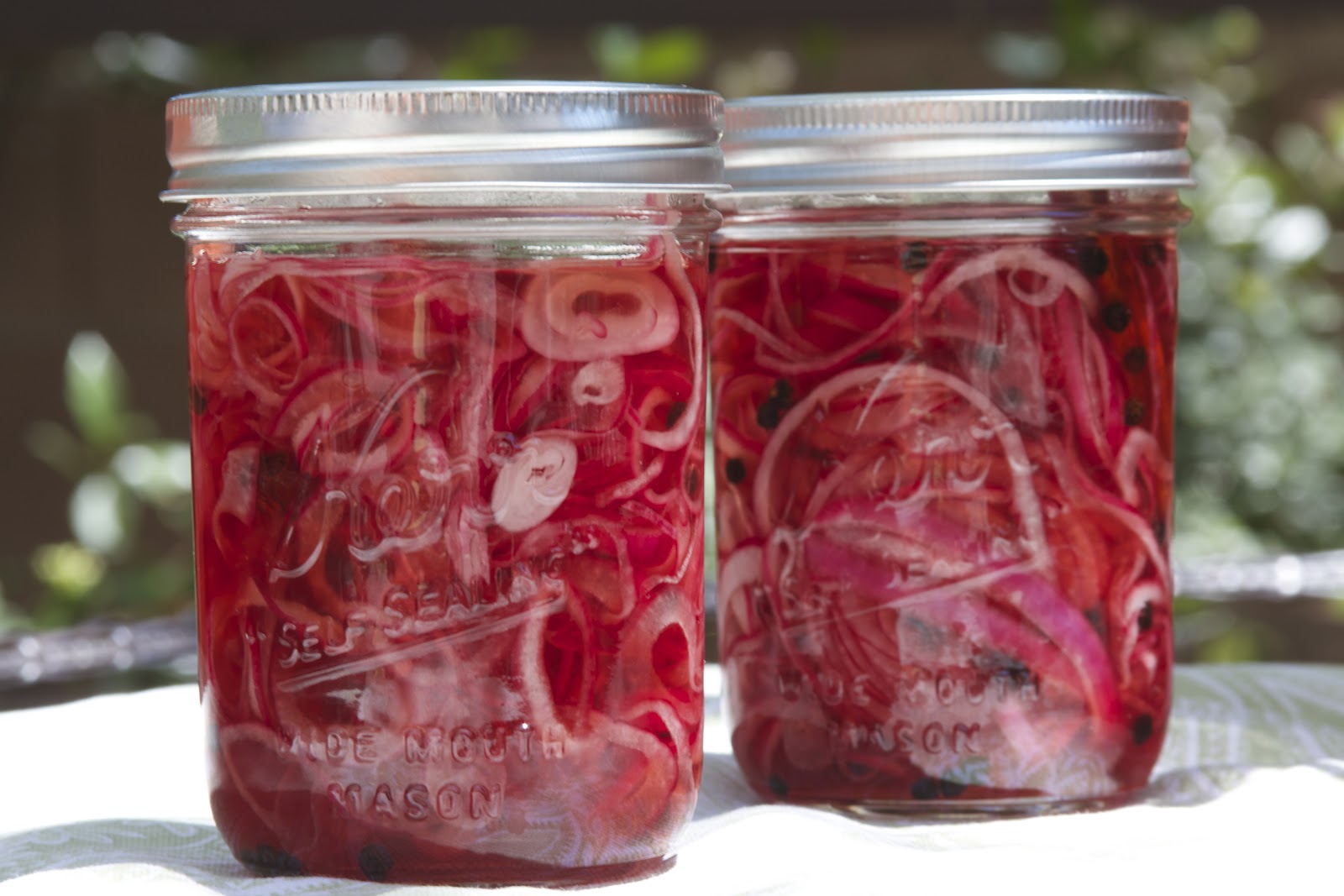
Quick Pickled Red Onions

Pickled red onions are one of my favorite condiments and this is a very easy way to make them.  I do not remember how I came upon this recipe in order to credit it properly, so if anyone recognizes it, please let me know!  I’ve had it in my recipe file for quite some time now, so at this point, I almost consider it “mine”!

1 large red onion, sliced thinly and placed in a glass bowl
1/2 cup sugar
1/4 cup red wine vinegar
1/4 cup white vinegar
1 1/2 teaspoons coarse kosher salt
1 1/2 teaspoons whole peppercorns
1/2 cinnamon stick

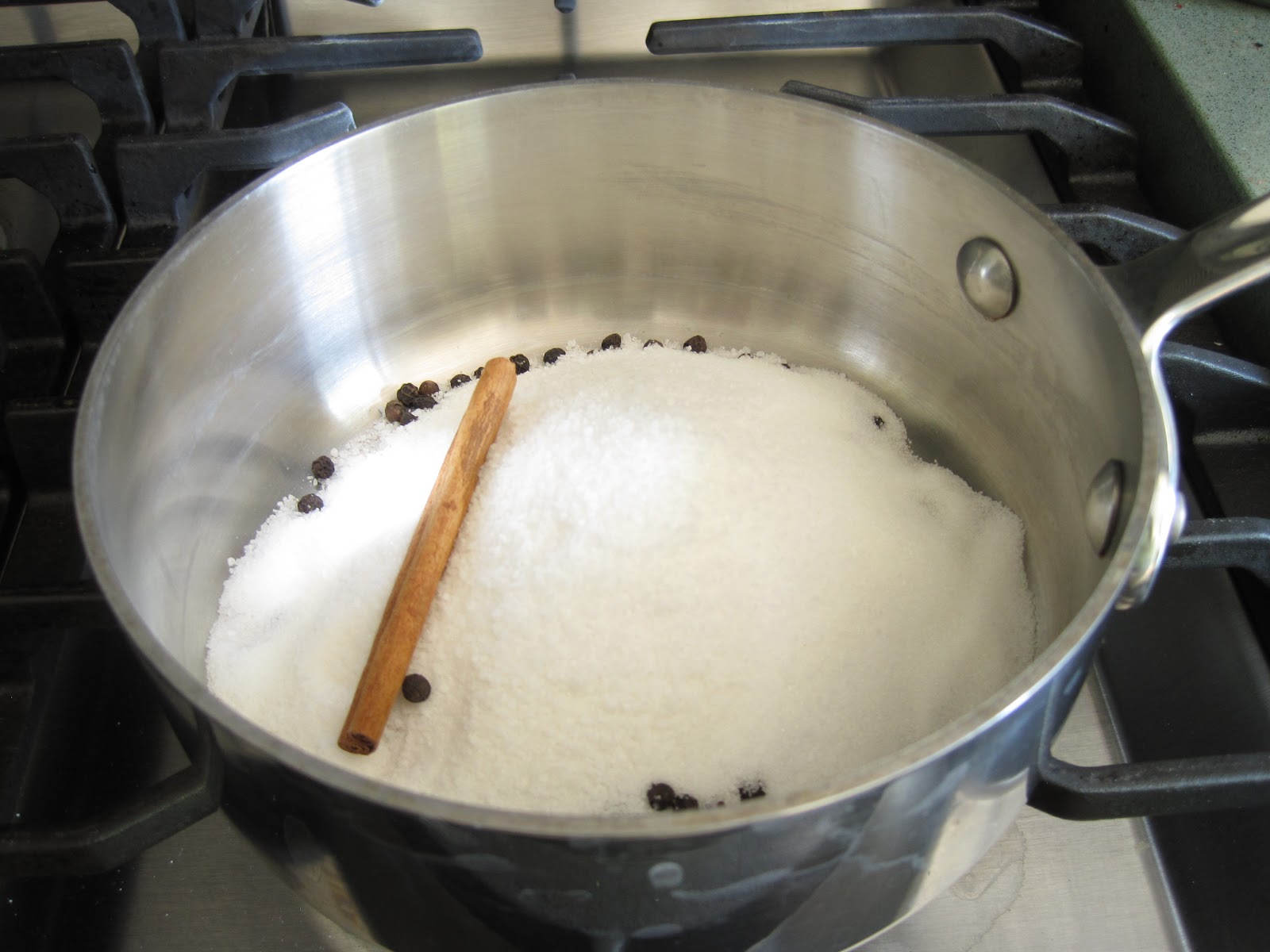
Combine the sugar, vinegars, salt, peppercorns and cinnamon stick in a small saucepan and bring to a boil.

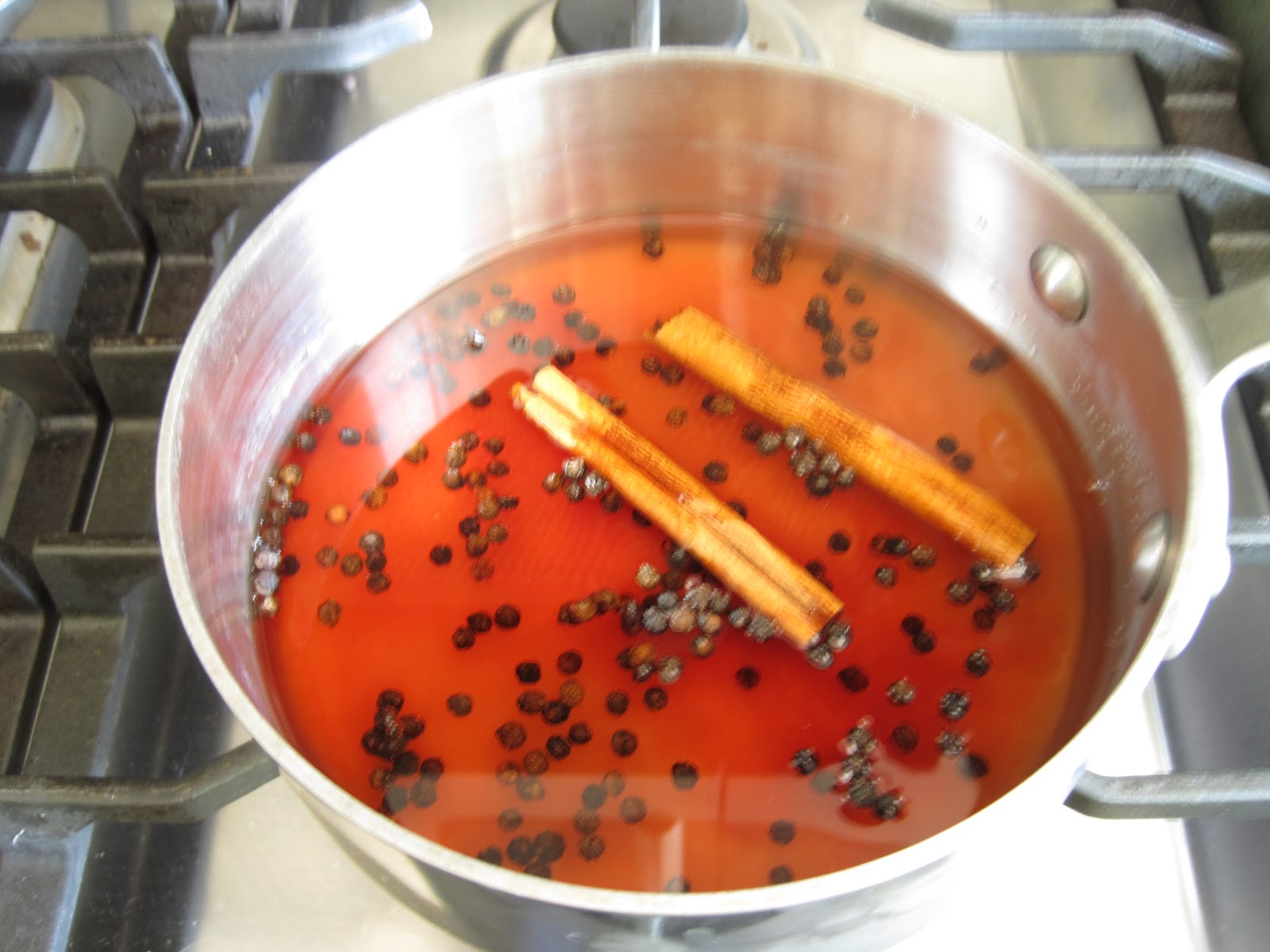
Once the sugar has completely dissolved, pour over the onions.  Bring to room temperature, then put the onions into a container and refrigerate.  These onions will last around three weeks refrigerated.

Pour vinegar mixture over onions

I like to put them on sandwiches, especially on Pulled Pork Sandwiches, but my favorite way to eat them is on a bagel with cream cheese, smoked salmon and capers!

Cue it Up: Pulled Pork Sandwiches on Light Brioche Buns

Yesterday was Mother’s Day and we celebrated by having both of our mothers to our home for a barbecue.  I did a lot of cooking.  I mean, a LOT.  I smoked a seven and a half pound pork shoulder, made some delicious pickled onions to go with it, barbecued chicken, baked beans and to top it off, some soft fluffy brioche buns to hold that delicious pork!  I was exhausted when it was all over, but it was fun and rewarding to honor our moms with a meal made with love that they didn’t have to cook themselves!

The first time I ever made North Carolina Style pulled pork sandwiches was the year that the New Orleans Saints won the Superbowl.  I remember this because that’s the Man of The House’s favorite team and that was a very festive football season!  We had planned a big Superbowl party and I decided to try my hand at smoking a pork shoulder.  We were living in a different house at the time, with a very tiny yard and we had a very small charcoal barbecue grill.   It was cold and raining that day, and I spent the day running in and out of the house in a raincoat and umbrella to stoke the coals and add more hickory chips.  It was nearly impossible to keep the temperature in the right zone because it was so cold and wet, but to this day, that was the best smoked pork I have ever had!

These days we have a larger yard and I have a big-girl gas barbecue grill, which I love, but truthfully, I long to have that deep smoked flavor that came from that baby-sized grill.  I may have to invest in a dedicated smoker one of these days, but until then, smoking on the grill is a good alternative.  This recipe is found in the book “The Barbecue Bible” by Steven Raichlen.

This kind of barbecue takes some time.  In fact, this last pork roast smoked for 12 hours before I took it inside.  I have heard from barbecue enthusiasts that most of the smoky flavor is imparted in the first three hours, so, if that is true and you wanted to save time by speeding things up, you could bring the roast inside and finish it in a dutch oven with a little liquid in a 300 degree oven.

First I made a spice rub:

1 tablespoon paprika
2 teaspoons light brown sugar
1.5 teaspoons smoked paprika
.5 teaspoon celery salt
.5 teaspoon garlic salt
.5 teaspoon dry mustard
.5 teaspoon ground black pepper
.5 teaspoon onion powder
.25 teaspoon salt

Rub this mixture onto a 5-6 pound pork shoulder roast or “Boston Butt” as it is also called.  Wrap it tightly in plastic wrap and place in refrigerator overnight.  If your roast is a little “loose” truss it with twine.

You’ll also need about 6 cups of hickory chips.  Soak these overnight as well, so that you don’t forget to soak them in the morning.  They will need to soak for about an hour.

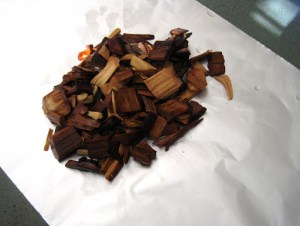
The next day as you prepare the grill, fill a smoker box with the soaked chips.  If you don’t have a smoker box, you can wrap the chips in a foil packet and poke holes in it.  Easy and inexpensive alternative!
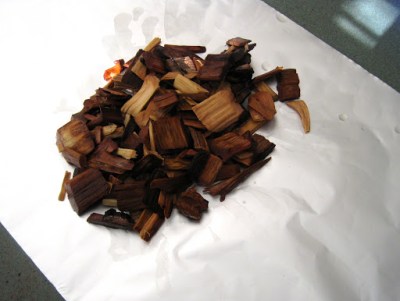
Wood chips on foil
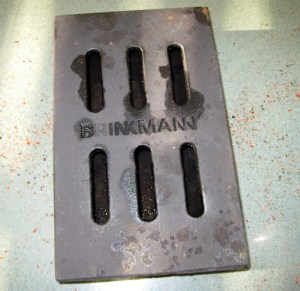
Cast iron smoker box

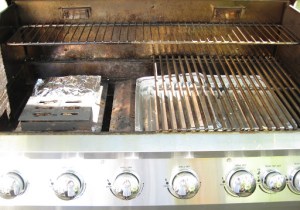
Now, set up your grill for indirect grilling.  This means that you won’t cook the meat directly above the flames (or coals if using a charcoal grill).   Here’s the setup with my grill:

As you can see, on the left side of the grill, I’ve removed the grill grates and placed a smoker box and a foil packet of wood chips directly on top of the burner shields.  On the right side, I have placed two disposable foil pans underneath the grates in order to catch the drippings.  Light the burners underneath the smoker box (or foil packets) and allow to preheat to 300 degrees.  Oil the grates and then place the pork roast fat side up on the unheated side of the grill.  Place a meat thermometer in the roast and if it’s digital, set the alarm to 195 degrees.
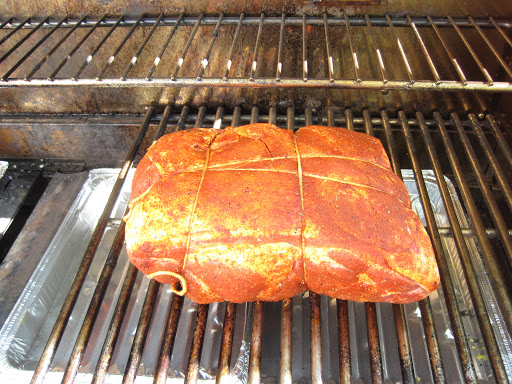
Place roast fat side up on the grill

You will need to periodically replace the wood chips as they burn out, so it’s a good idea to pre-make several foil packets if you’re using them.  Place the spent wood chips into a metal container until they burn out completely.
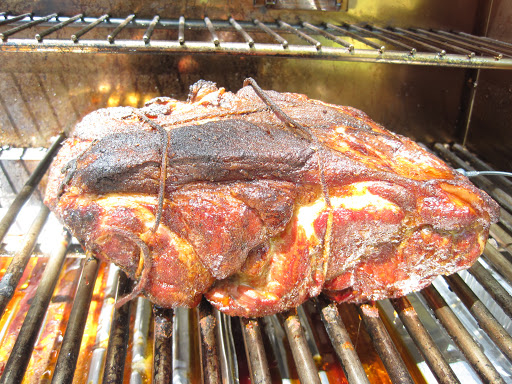
After about six hours

The odd thing that happens with the roast is that it hits a temperature plateau around 161 degrees and it just sits there, not budging.  Then after a while, it goes over the hurdle and finally makes its way to 195 degrees, which is the temperature that makes “pulling” possible.  After it reaches 195 degrees, bring the roast inside, place it in a roasting pan and allow it rest.  After it has cooled down, start pulling the meat apart, separating and discarding any skin and fat.
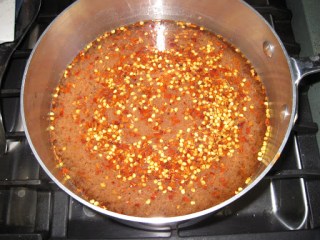
I know that different regions in the country have their favorite barbecue sauce, but I really love this vinegar sauce for the pulled pork and I also used this same sauce for the barbecued chicken.

Vinegar Sauce:

2 cups apple cider vinegar
1/2 cup plus 2 tablespoons ketchup
1/4 cup packed brown sugar
5 teaspoons salt
4 teaspoons red pepper flakes
1 teaspoon ground black pepper
1 teaspoon ground white pepper
1 1/3 cup water

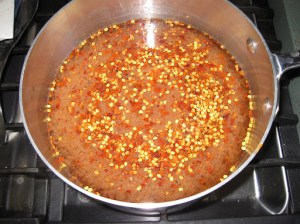
Combine all of these ingredients in a saucepan and reduce it by about 25 percent.  Pour half of the sauce into the meat and reserve the rest for people to pour onto their pulled pork, if desired.  The red pepper flakes give it a nice, spicy kick!

Now for those buns!  I will begin by telling you that I am a novice baker.  In fact, it has only been this year that I became brave enough to attempt baking bread.  Now that I’ve made a couple of different bread recipes, I’m becoming a little more confident and I really enjoy it!  Plus, you can’t beat the taste and the scent of freshly baked bread.

I don’t have a stand mixer, but I learned over the weekend that I can make bread dough right in my Cuisinart food processor.  I had to make some adaptations to the recipe to account for the speed and increased heat of the food processor, but the results were exactly the same as the first time I made them using a stand mixer.

The original source of this recipe came from the New York Times, but I came upon the recipe by way of one of my favorite food blogs, Alexandra’s Kitchen.  I have to give Alexandra the credit for her virtual hand-holding through my first time making these buns! Here is a link to Alexandra’s blog and the Light Brioche Buns recipe.  I will give you my adaptations for using a food processor:

3 tablespoons warm milk
2 teaspoons active dry yeast
2 1/2 tablespoons sugar
2 large eggs
3 cups bread flour
1/3 cup all purpose flour
1 1/2 teaspoons salt
2 1/2 teaspoons unsalted butter, softened

If using a food processor,  in a glass measuring cup, combine 1/2 cup warm water, the milk, yeast and sugar.  Let stand until foamy (about 5 minutes).  Beat one egg and set aside.  Set aside 1/2 cup cold water.

Place the dough blade in the food processor.  In the bowl of the food processor, add the flours, the salt and the softened butter.  On the dough setting, pulse until combined.  With the machine running on the dough setting, pour the yeast mixture and the egg into the small feed tube as quickly as the flour can absorb it, then add the 1/2 cup of cold water.  When the dough cleans the sides of the bowl and forms a ball, continue running the machine on the dough setting for exactly 45 seconds to knead the dough.  It’s very important not to over-knead the dough as the friction from the machine makes the dough very warm, which can kill the yeast.  This is also the reason for adding 1/2 cup cold water to the dough–it brings down the temperature of the dough.  Remove the dough from the food processor and shape into a ball on an un-floured countertop.  Place the dough ball in a bowl and loosely cover with a kitchen towel and place in a warm spot for 1 to 2 hours until it has doubled in size.

Line a baking sheet with parchment paper.  Divide the dough into 10 parts and shape the dough into balls and place 2-3 inches apart on the baking sheet.  Cover loosely with a kitchen towel and allow them to rise in a warm place for 1 to 2 hours.

Still haven’t gotten the hang of making perfect dough balls!

Set a large, shallow pan of water on the oven floor and preheat the oven to 400 degrees.  Beat the remaining egg with 1 tablespoon of water and brush the tops of the buns.  You can also sprinkle some sesame seeds on top.  Bake for 12-15 minutes turning the pan halfway through.  Transfer to a rack to cool completely.

Mango Banana Daiquiris

This Sunday, we are inviting our mothers to join us at our home for a barbecue; and when I say barbecue, I mean pulled pork that’s been slowly smoked for hours, barbecued chicken, baked beans, corn-on-the cob, and coleslaw! At first, I had planned on making more traditional (and more ladylike) brunch fare–perhaps a quiche, a cake, finger sandwiches…but then it hit me that my mother has been wanting me to make pulled pork for quite some time and I simply haven’t had the time to make it–it takes about 4 to 6 hours to smoke.  Now that our propane grill has been converted to natural gas, it’s easier and more convenient to smoke a large roast without worrying that I’ll run out of propane before the meat is done. So, now that there aren’t any excuses, I’ll be smoking that pork shoulder roast all day tomorrow!  At this moment, the pork shoulder roast is marinating in a spice rub.  I’ll be posting the recipes and the how-tos throughout the weekend!
To get things off to a good start, this mango-banana daiquiri will definitely be on the menu!  I think these daiquiris will get the moms in the mood to relax and enjoy their day–because that’s really what moms really need right?
This recipe is from Ina Garten’s “Barefoot Contessa Back to Basics” and I really love the fact that it can be made in a large batch in a blender.  It’s sweet and full of tropical flavor and I think the drink is perfect to serve for Mother’s Day brunch, whether you’re having something ladylike or getting down to some serious finger-licking grub!

Mango Banana Daiquiris

  • Servings: 4
  • Difficulty: easy
  • Print
Source:  Barefoot Contessa, Back to Basics
It’s important that you use mangoes that are nice and ripe–you can tell they are ripe when they give a little when you squeeze them.  If your mangoes aren’t quite sweet and ripe enough, you can always add some canned mango nectar to sweeten it a bit.
  • 2 cups chopped ripe mango
  • 1 ripe banana
  • 1/2 cup freshly squeezed lime juice (4 limes)
  • 1/4 cup simple syrup*
  • 1 1/4 cup dark rum
  • Mango Slices for garnish
  1. Add the mango, banana, lime juice, simple syrup and rum to a blender and puree until smooth.
  2. Add 2 cups of ice and blend until it is smooth and thick.  Garnish with the mango slices.  Could this be any easier? I don’t think so! Makes 4 drinks.
*simple syrup:  heat 1 cup sugar and 1 cup water in a sauce pan until the sugar completely dissolves.  Chill before using.

Garden Update: How Does Your Garden Grow?

As I write this I’m sitting in the backyard with my laptop, tiki torches lit, listening to Adele playing through a bluetooth speaker and feeling grateful for the modern technology that allows this.  And then around the corner lies the very non-technological garden plot that flummoxes me and supplies me with new mysteries to contemplate each and every day.

I should clarify that the reason I am blogging about our gardens is not because we are experts in gardening.  These gardens, both the traditional soil garden and the aquaponic garden, are works in progress and we are learning through trial and error, as well as getting advice from friends and friendly folks we meet at the garden center. When I last wrote a garden update, things seemed to be progressing very nicely.  We had had a series of windstorms that wreaked some general havoc, but all the plants were healing up nicely.  Today, there are some new developments and some explosive growth as well as a few plants that I’m about to write off as a fail.  Now, I am not one of those people who has a “green thumb” who can make anything grow with little effort.  Nope, my thumbs are most assuredly brown, but  like I said, I’m learning!  But because I’m a novice gardener with brown thumbs, I’m also a constant worrier.  Am I fertilizing enough? too much?  Are the plants getting enough water? too much water? Should I be worried about those funny white spots? Why are the cucumbers and squash withering on the vine? What is eating all of my petunias?!
Aquaponic Garden

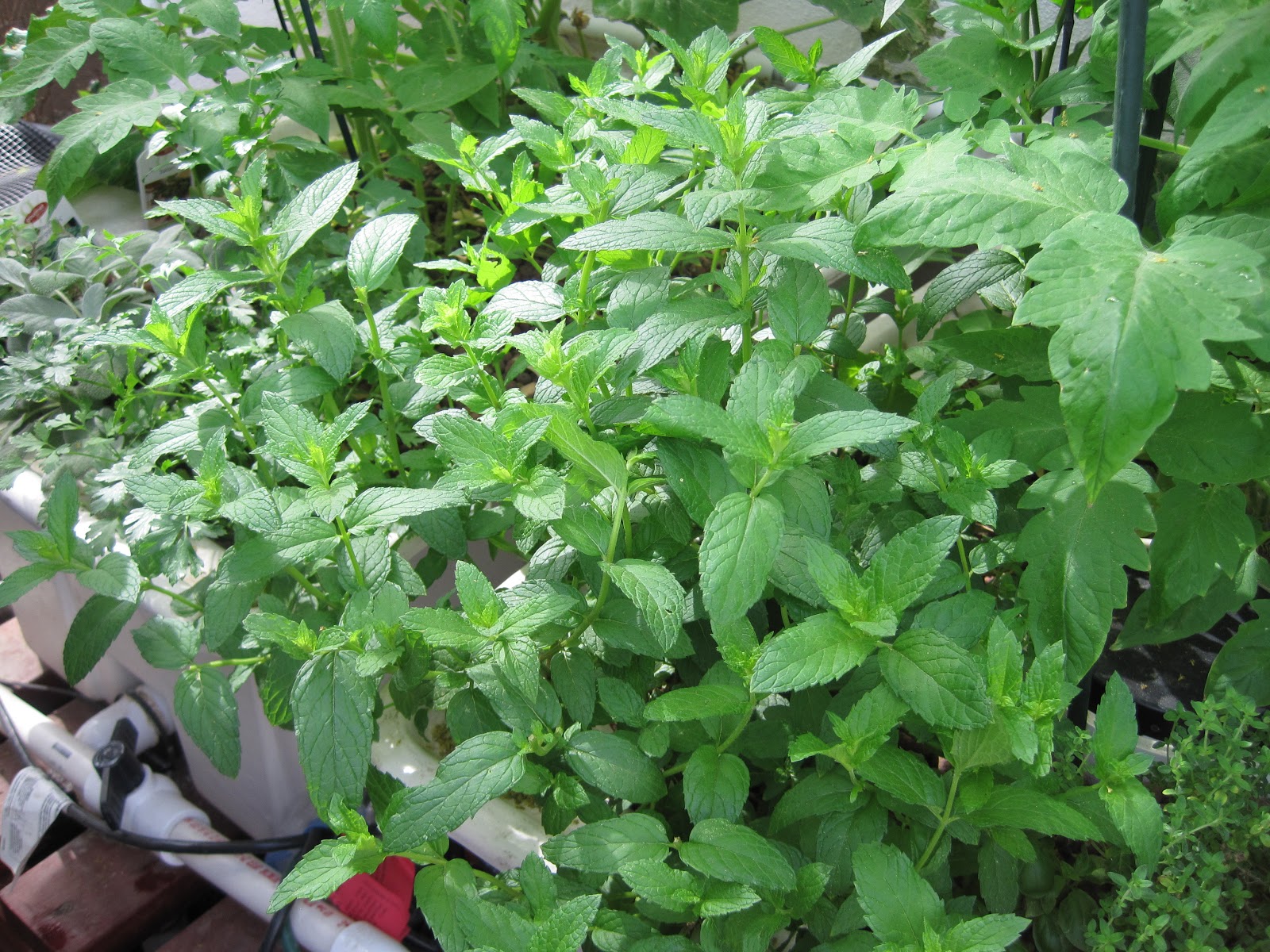
Aquaponic Garden: mint, thyme 

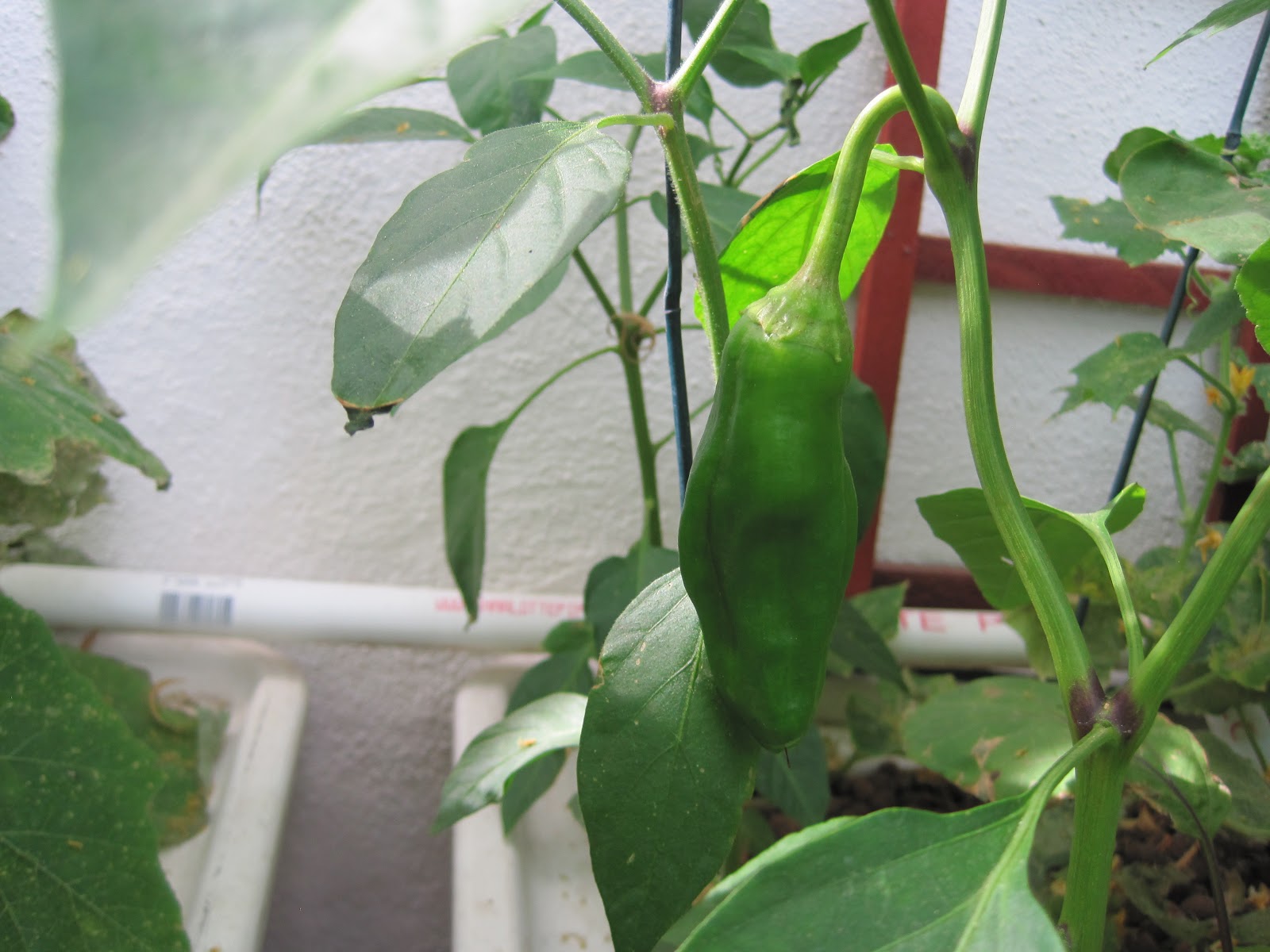
Aquaponic Garden: Anaheim chili pepper

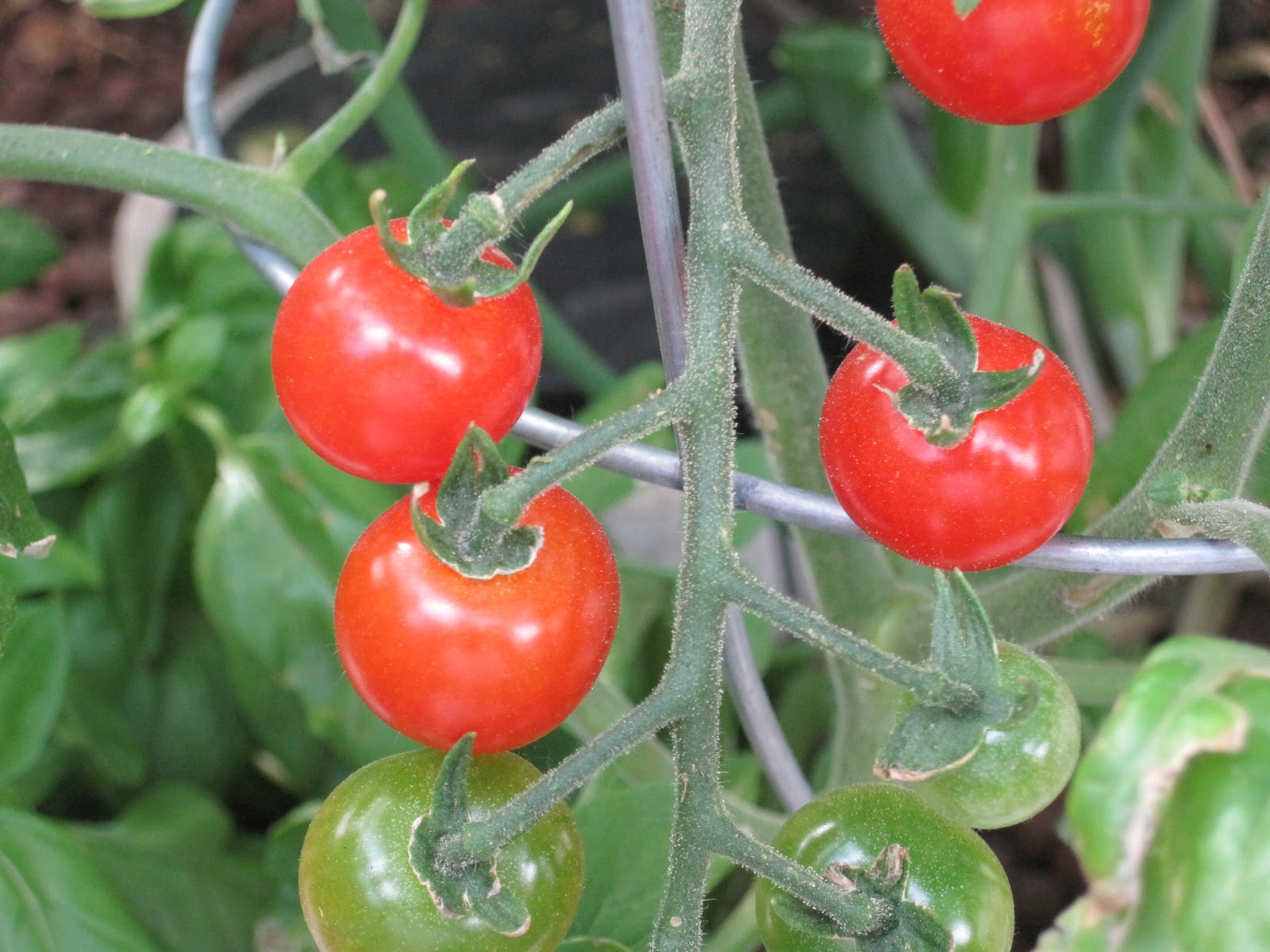
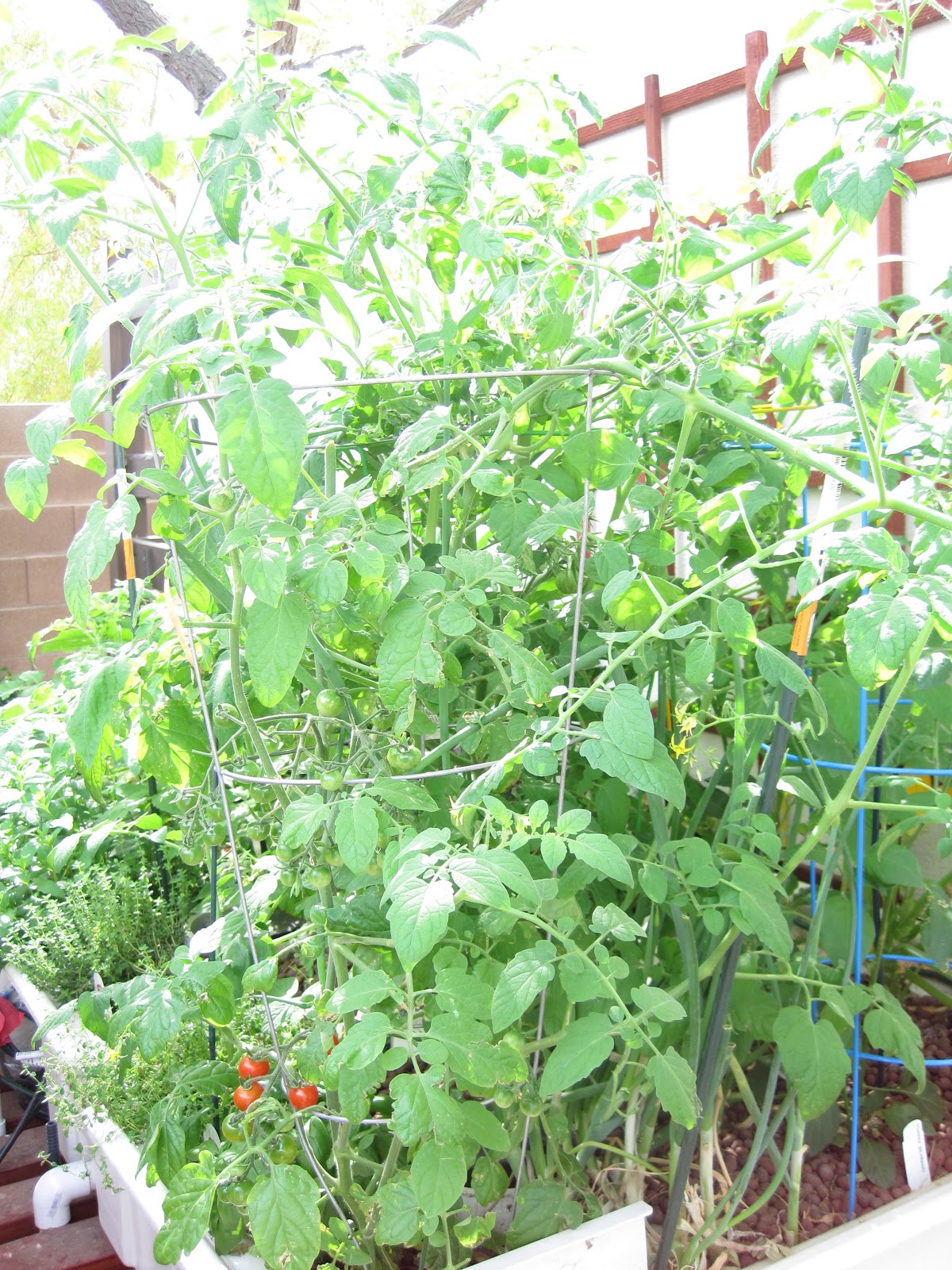
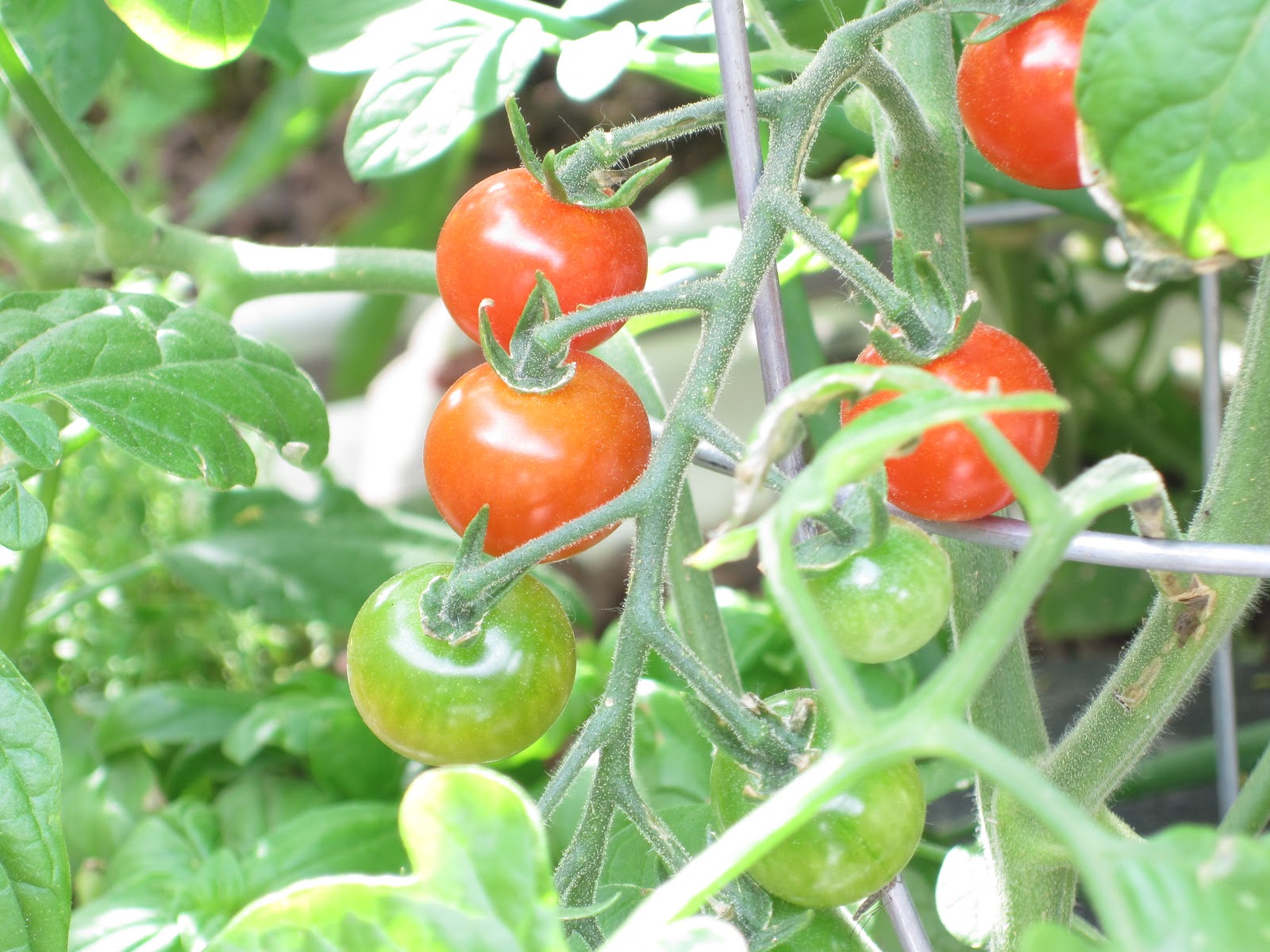
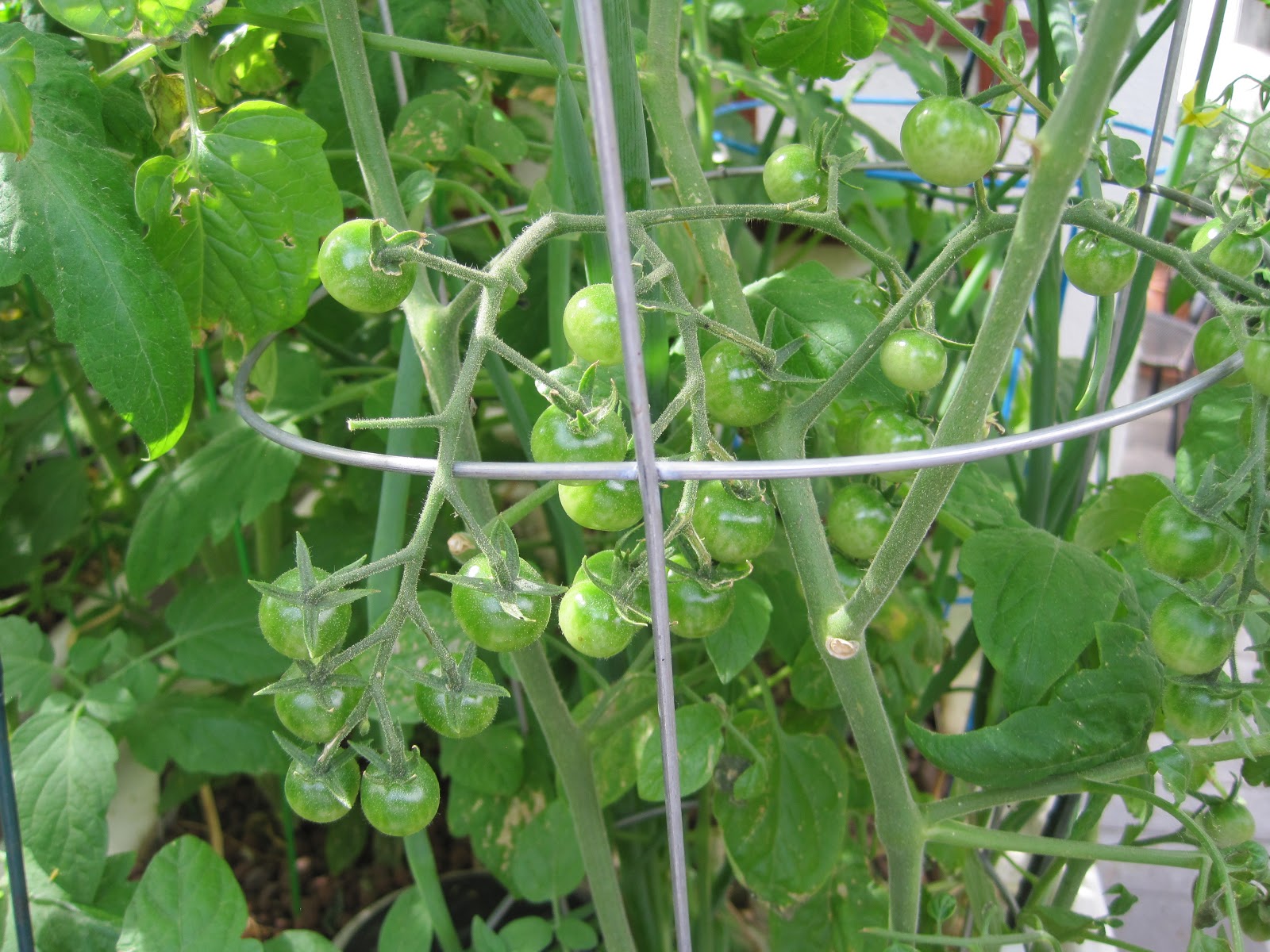
I’ll get to some of these questions, but first, I’ll start with the exciting stuff!  The Sweet 100 tomatoes are starting to turn red already!  It seems early to me, but I’m not going to complain about it!  They are still rather small and I joked today that I was going to make the worlds tiniest caprese salad with them.  But what they are is numerous!  They don’t call them Sweet 100s for nothing!  The plant in the aquaponic bed has at least 50 little tomatoes on it and the plant itself is getting huge!  The rest of the tomatoes are doing very well, each with fruit and flowers…except for one.  The “Early Girl” in both beds still hasn’t set flowers! So, now, I shall dub it “Late Girl”.  I’m pretty sure that the Early Girl tomatoes we planted last year had fruited by this time, so it is a mystery as to why it’s holding back.

Aquaponic Garden: Sweet 100 tomato
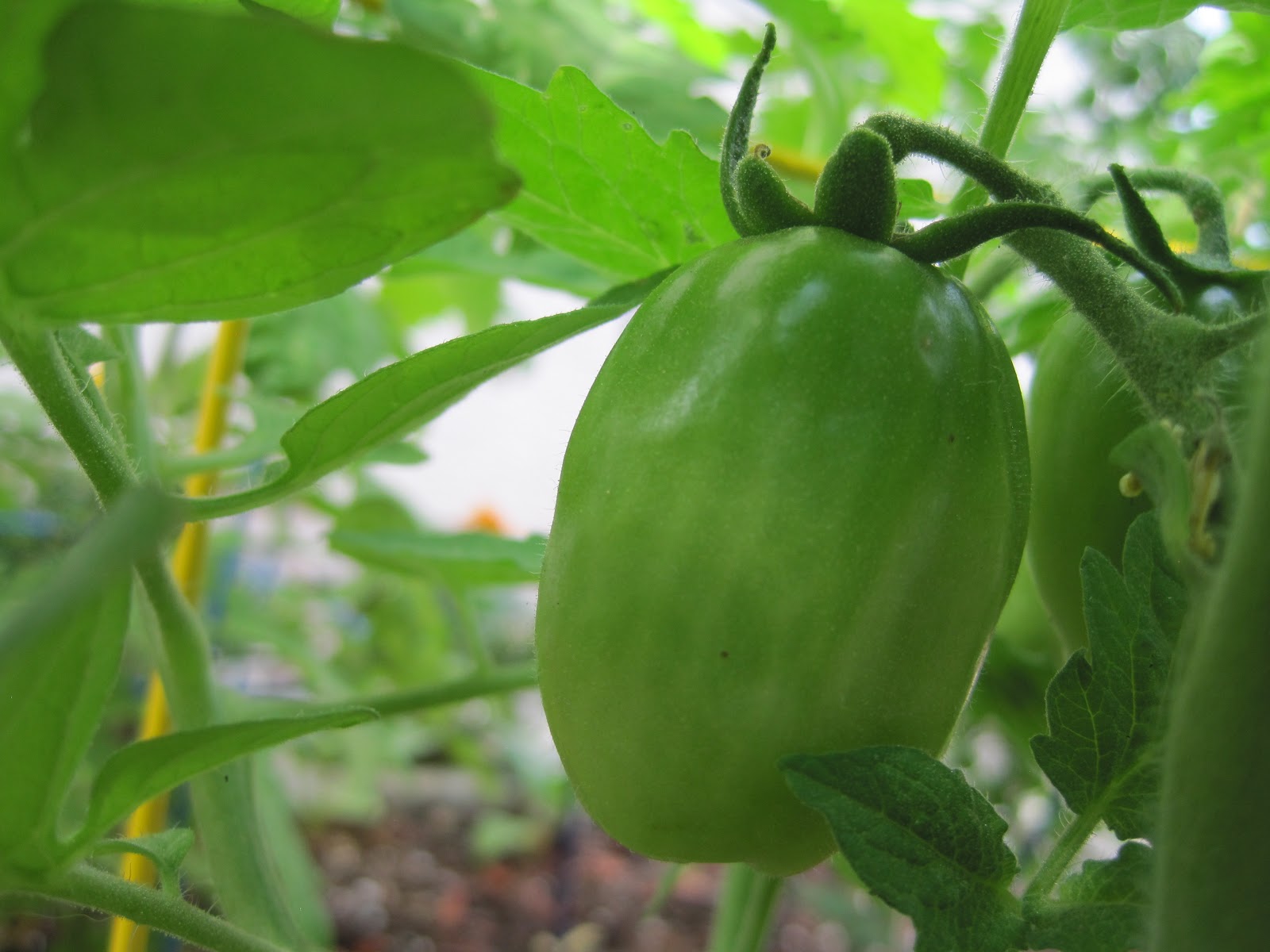
Traditional soil: San Marzano Tomato

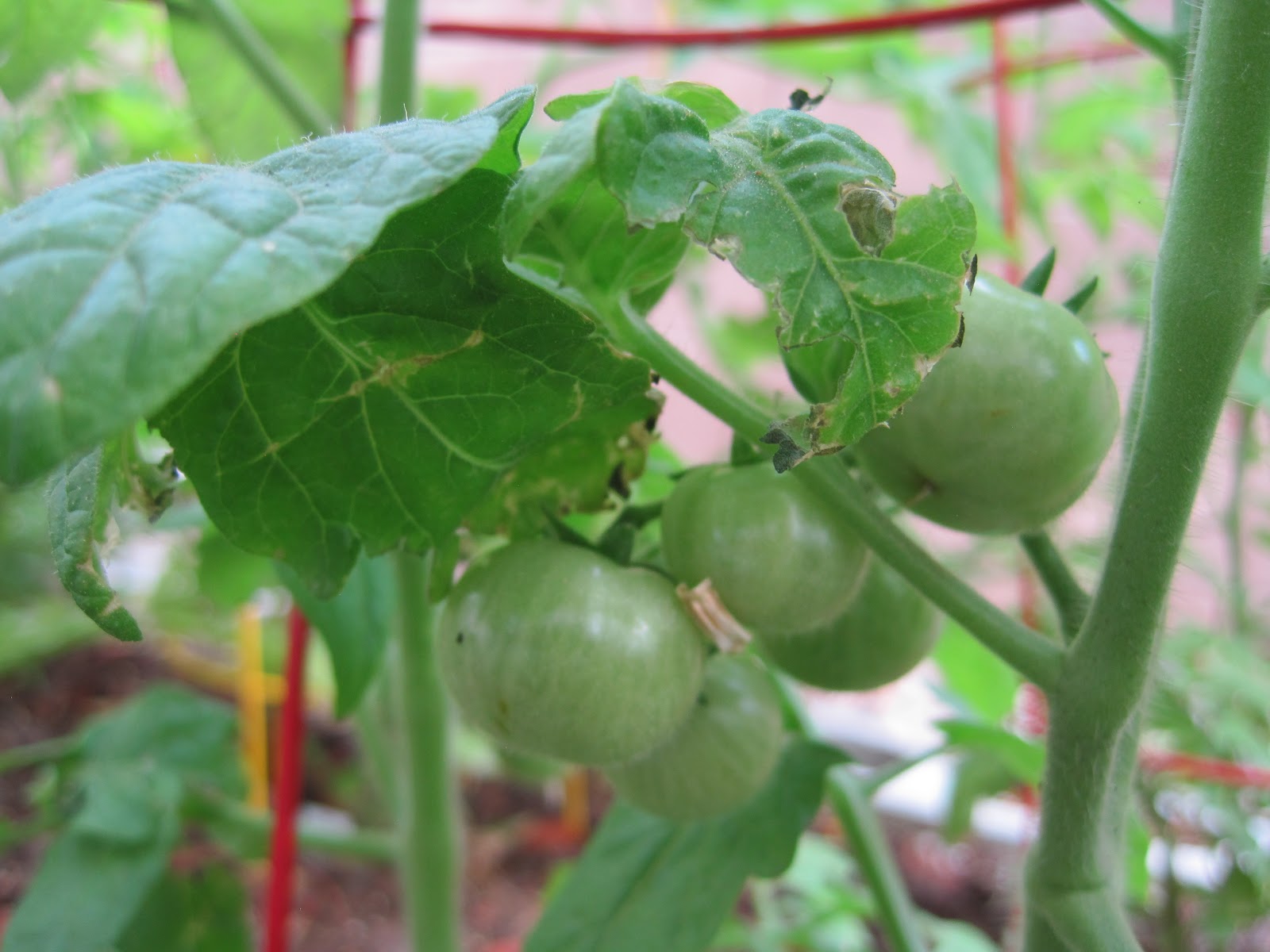
Traditional soil garden: Patio Tomato

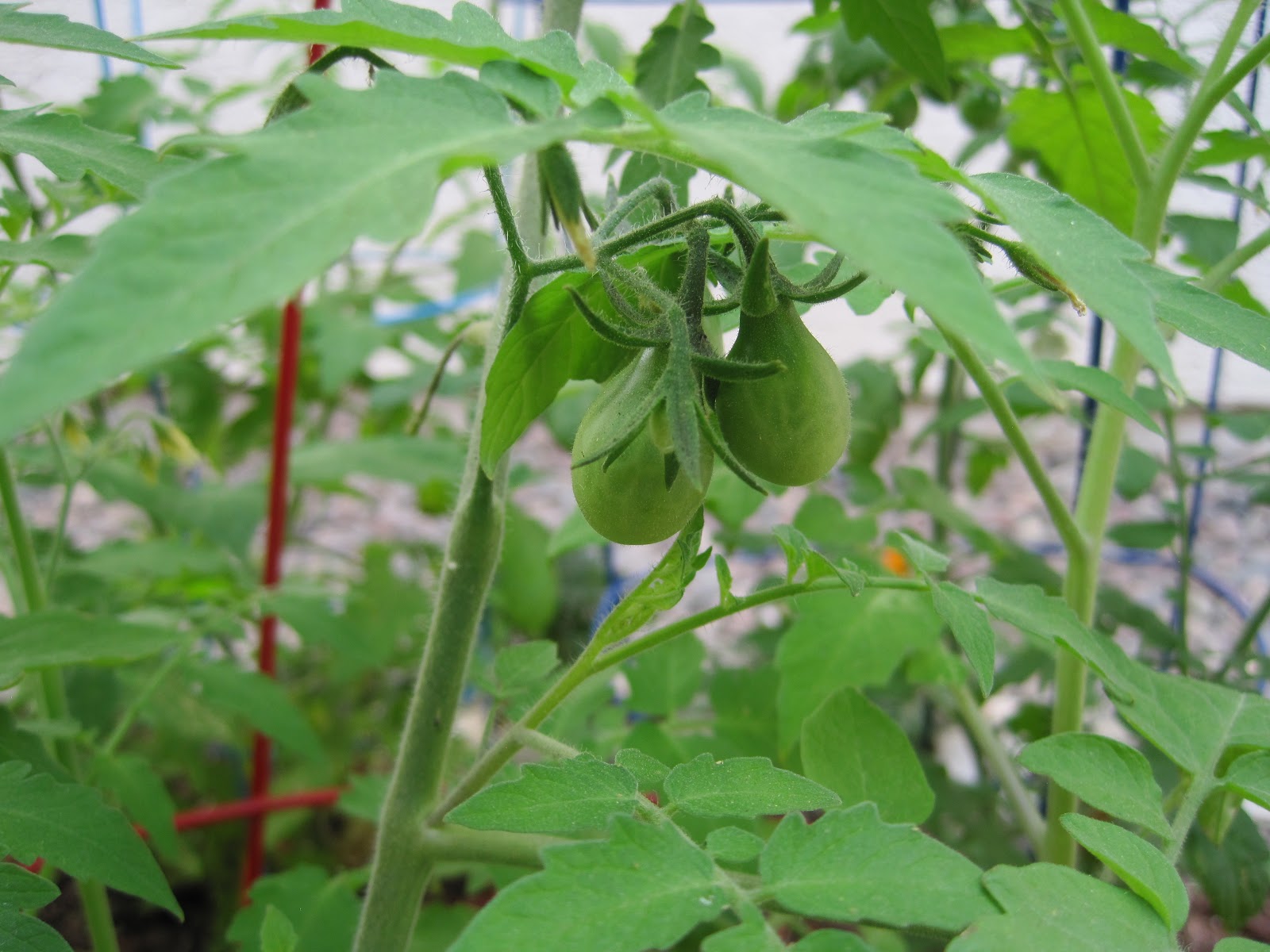
Traditional Soil Garden: Yellow Pear Tomato
Aquaponic Garden: Sweet 100

Our gardens are currently located on the northern side of our east-facing backyard.  What that means is though our backyard gets wonderful morning sun, the side yard doesn’t get the requisite eight hours of sunlight that a garden should have.  So, while the gardens are growing very well, the plants are competing for the available sunlight and some of them aren’t thriving as well as they could be.   
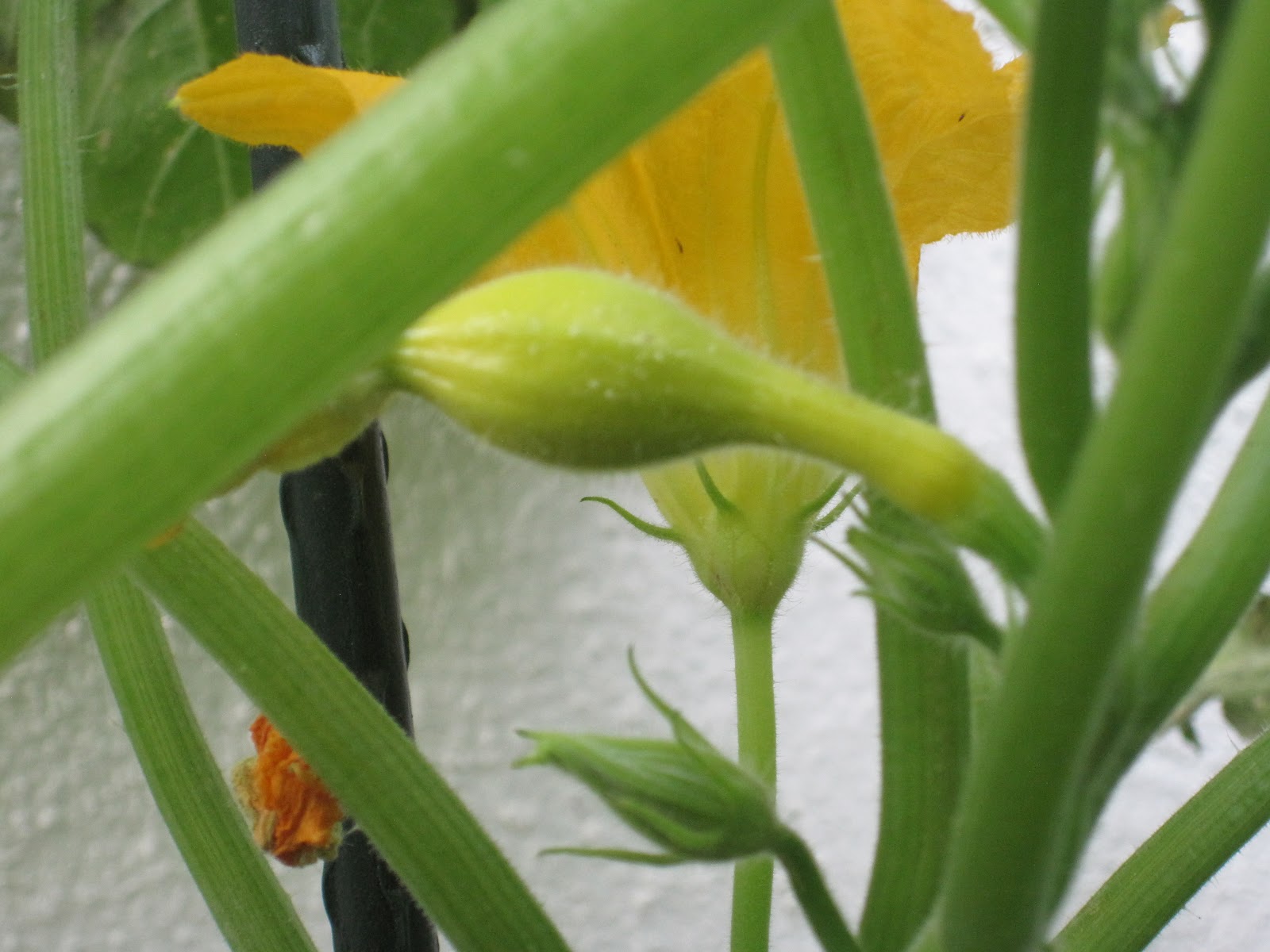
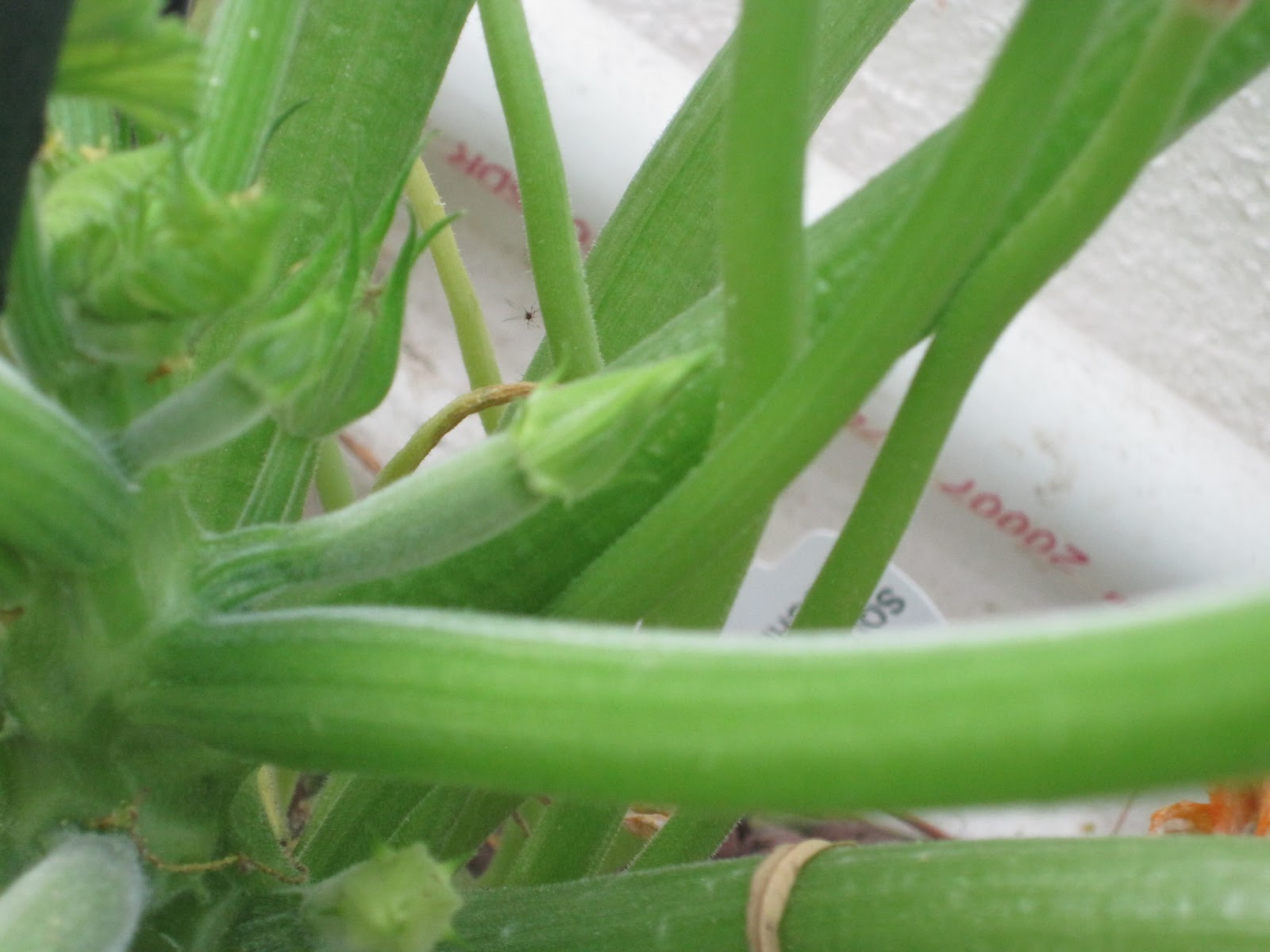
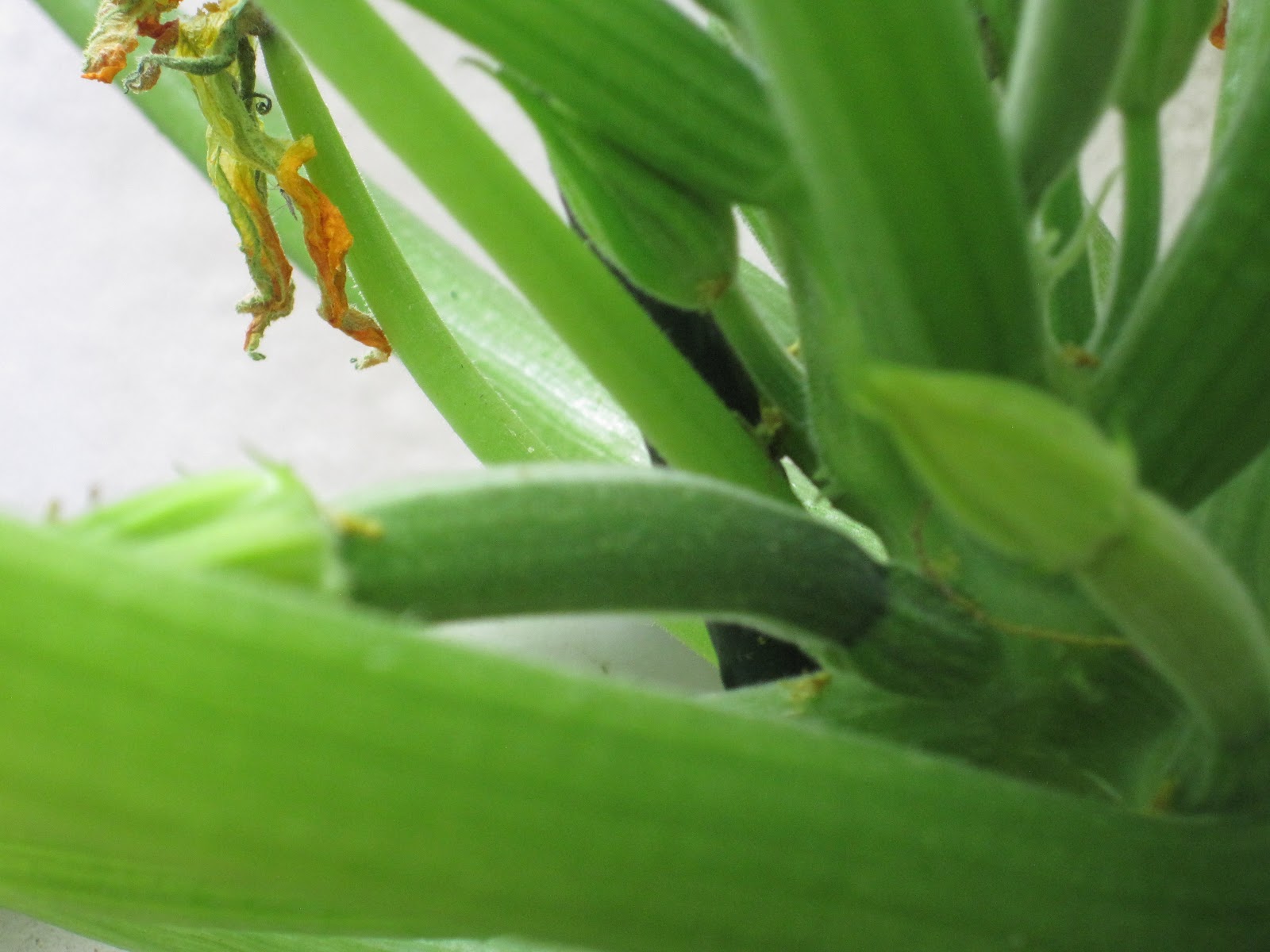
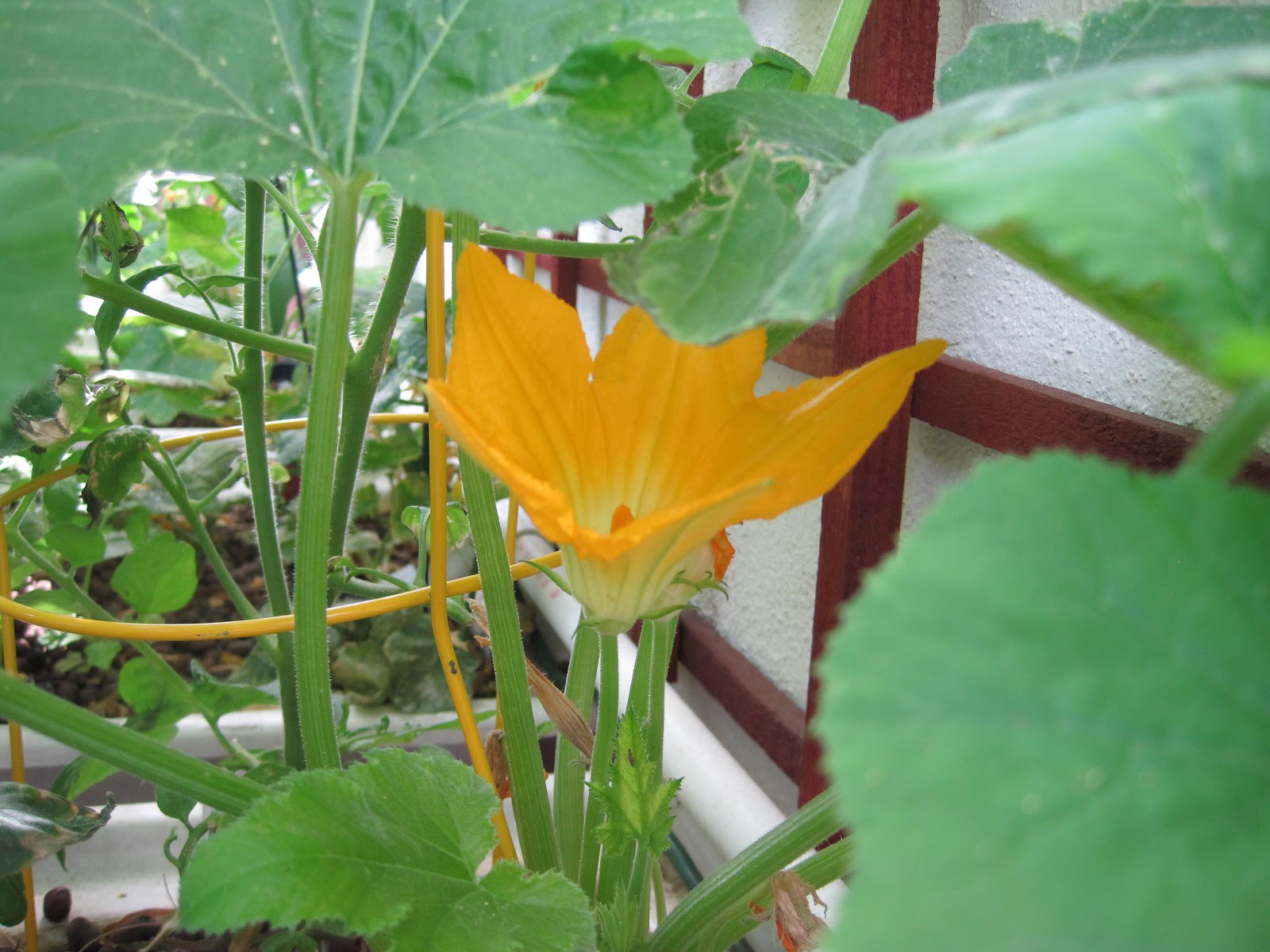
Something else we’re learning about is fertilization.  I don’t know if anyone else has noticed, but there is a huge shortage of bees, and the one bee that seems to have been assigned to our yard doesn’t seem to realize that there are lots of flowers just around the corner that need fertilizing!  We have come to the realization that some of our plants will have to be fertilized by hand.  Which brings me to the zucchini and yellow squash.  Until recently, I did not realize that not every flower on the squash plants become a fruit, as do the tomatoes.  Each plant has both male flowers and female flowers and they do not self-pollinate.  The male flowers are large and showy and last about a day and then they shrivel and fall off a few days later.  The female flower contains a miniature version of the fruit right in front of the flower bud.  You can tell them apart because the male flower is on an evenly thin stem and the female is thicker and bulbous.  So, while we were excited to see the first crookneck squash growing, that excitement turned to dismay when the little squash eventually shriveled up and fell off.  Then it happened again, and I started to panic!  My fantasies of hauling bushel baskets of squash around to the neighbors were fading quickly!  I did a little research and found that the problem was lack of fertilization.  That lazy bee!  Now we are being vigilant and waiting for the female flower buds to open so that we can quickly transfer pollen from the male flower with a cotton swab.  Plant sex….we’re having it.

Aquaponic Garden:
Yellow crookneck squash (female)

Aquaponic Garden: Zucchini squash (female)

See the zucchini forming?

Aquaponic Garden: Zucchini squash flower (male)

Oh, and remember I mentioned those funny white spots?  Turns out it is some kind of powdery mildew that needed to be treated or it would spread to other plants.  I found a recipe online to combat this:  1 teaspoon of dish soap, 4 teaspoons of baking soda to one gallon of water.  I’ve been spraying this mixture on the leaves every day and so far, it seems to be working.  Have I mentioned how thankful I am for the internet?
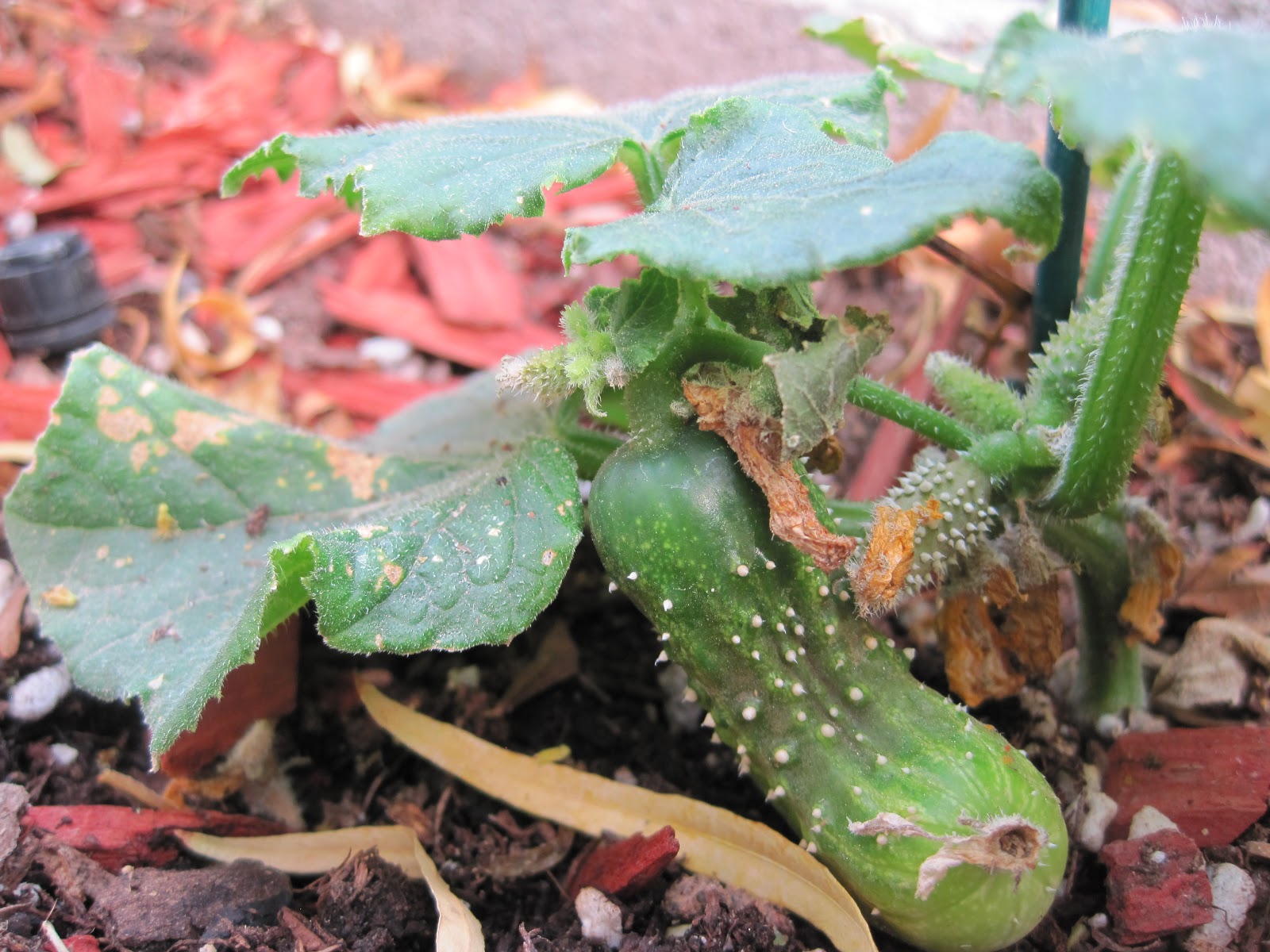
The cucumbers are not doing very well at all.  They just don’t seem to be growing at all and the little tiny cucumbers are shriveling and falling off.  The leaves are mottled and crispy. I suspect it is partly a fertilization issue, like the squash, but I also worry that they are simply not getting enough sunlight.  I’m going to plant some new cucumber plants in a pot in a sunnier spot in the backyard and see if it makes a difference.

Traditional Soil Garden: Pickling cucumber, doing badly

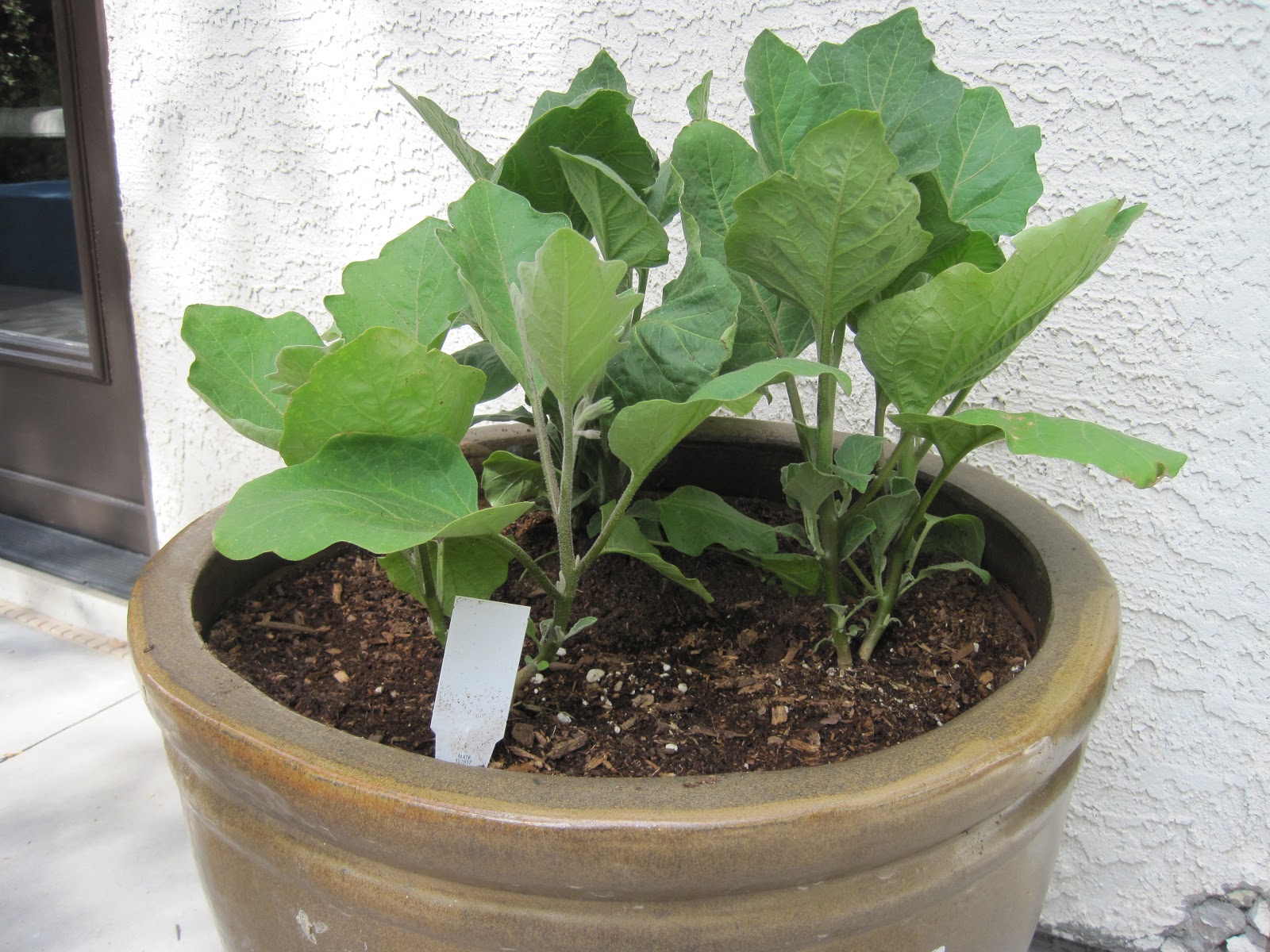
Today, I planted some new eggplants in a pot to see if they will do better with more sunlight.  Eggplants are self-pollinating, like tomatoes, so, at least that’s not the reason they aren’t doing well.  The Japanese eggplants in the traditional bed are not thriving and the plants aren’t hardy enough to support fruit.

New Eggplants!

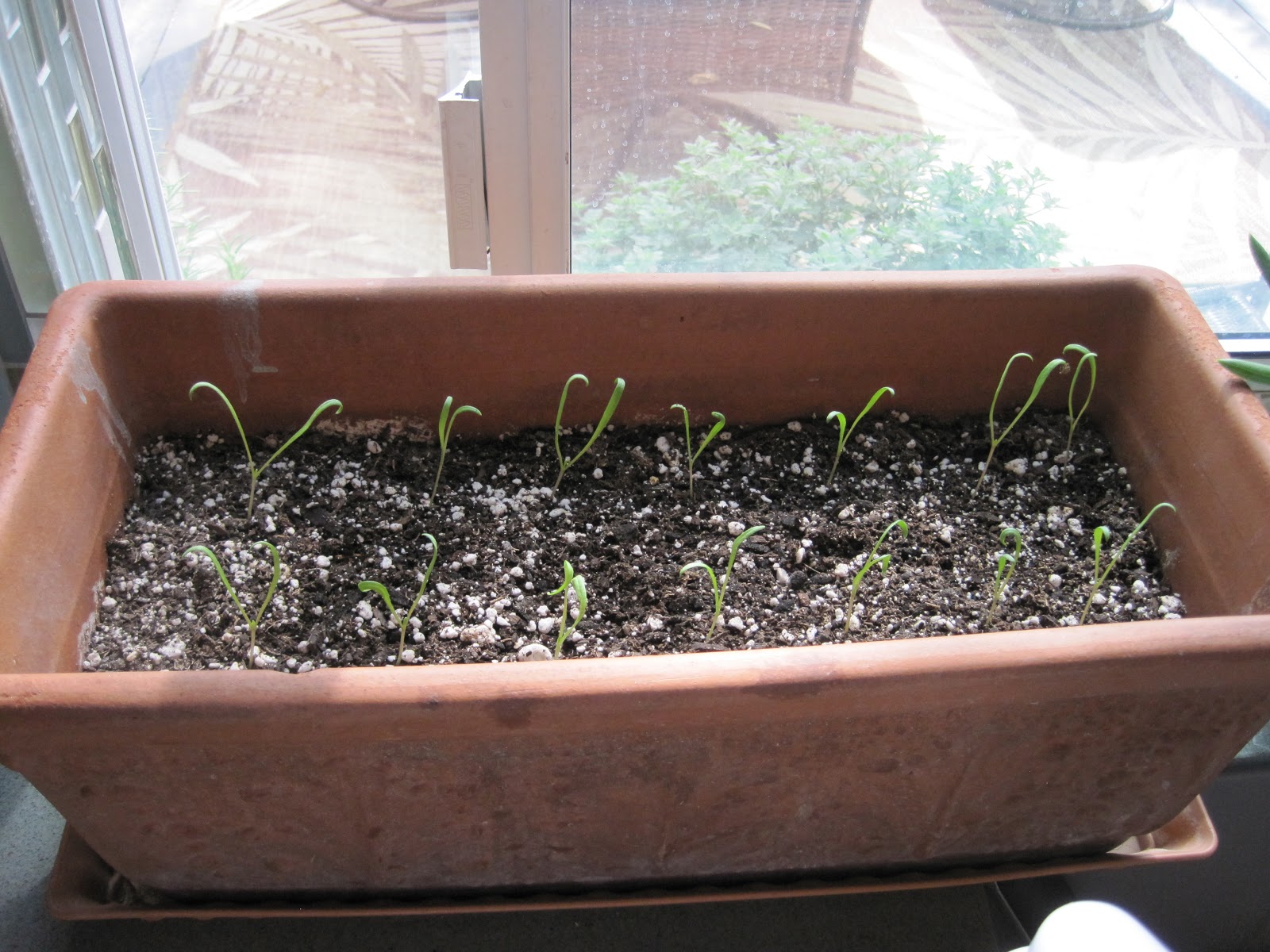
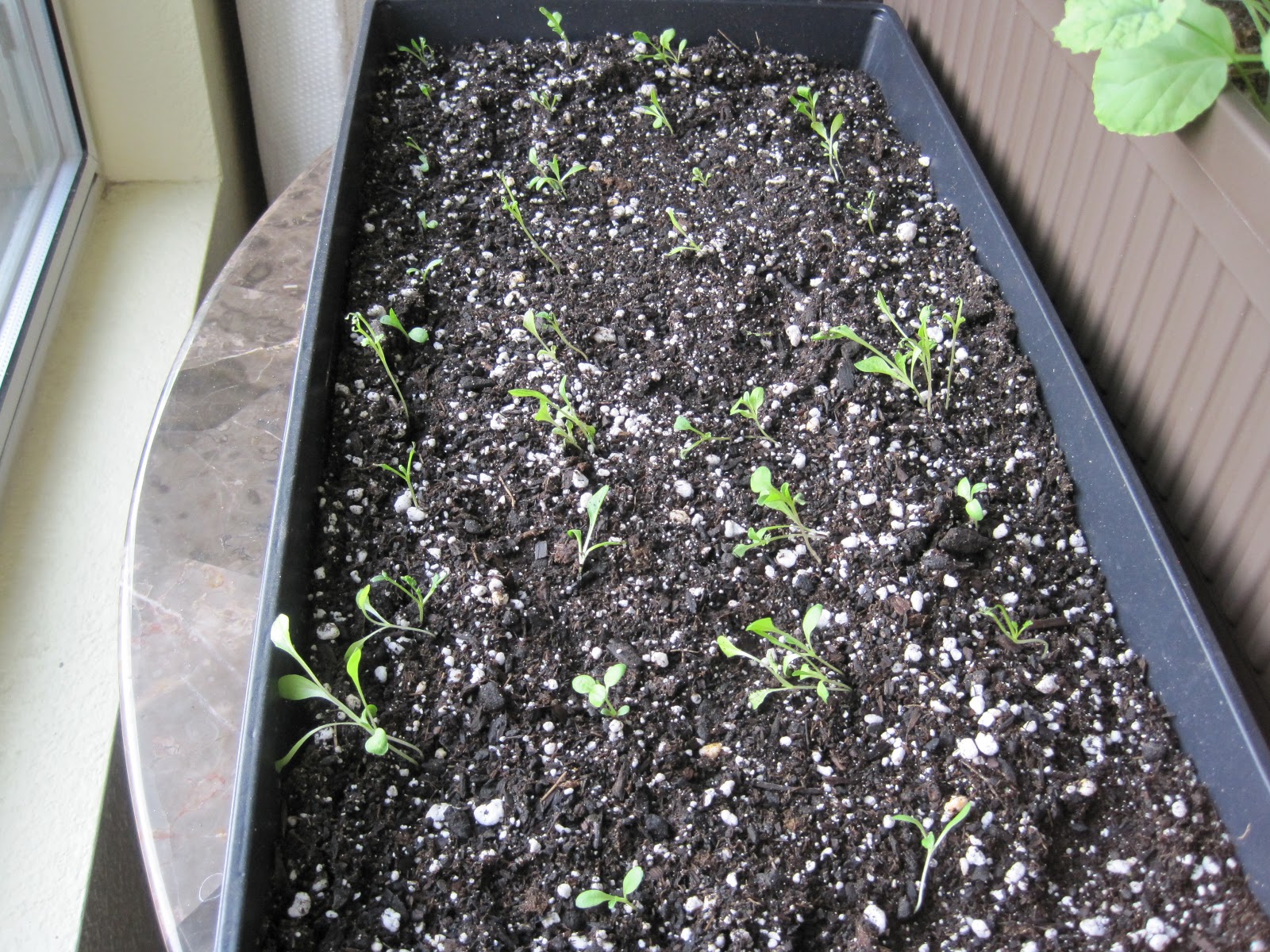
On a positive note, on Earth Day, I planted a flat of mesclun and a window box of spinach.  So far, they are growing well!  According to the mesclun package, they should be ready to harvest by May 22!  Here’s how they are doing so far:

Spinach, planted on April 22

Mesclun planted April 22
So, that is how my gardens are growing! I would love to hear how your garden is growing and what challenges you’ve had as well as any advice you might have for us as well!

The Cesar Ritz Martini

It’s Friday and it’s cocktail time!  I was thumbing through one of our cocktail books this afternoon,  “The Modern Mixologist”, by Tony Abou-Ganim.  Normally what happens when I’m looking for cocktail inspiration, I come upon a drink that looks absolutely mouthwatering, but then I find that it requires me to either buy an exotic ingredient, or what happens more often, requires an infusion that takes one to two weeks to prepare.  So, you can imagine my excitement when the book fell open to reveal a cocktail that was not only easy to prepare, but included everything that I already had in my pantry and refrigerator. I made a small substitution–the recipe called for English cucumber and I only had a good, old-fashioned regular cucumber, but I think the only difference it made was the final presentation.  In short, it was tasty and refreshing and perfect for a Friday evening after a long work week.

The drink is called the Cesar Ritz Martini and the author created it as a signature drink when he was working with the staff of the Ritz-Carlton to revive some classic cocktails.  The spirits used here are Plymouth Gin and St. Germain liqueur, which you may remember as one of the ingredients in the Framboise 75.  I have really fallen in love with the sweet, floral flavor of the St. Germain.  It’s sweet enough that simple syrup isn’t needed in the cocktail, yet it isn’t cloyingly sweet.

2 ounces Plymouth Gin
1 ounce St. Germain Elderflower liqueur
6 chunks of peeled cucumber
10-12 fresh mint leaves
1 ounce freshly squeezed lime juice

Muddle the mint leaves and cucumber with the St. Germain in a mixing glass (or the glass portion of a Boston Shaker).  Add the lime juice and the gin.  Shake with ice until well mixed and strain into a chilled cocktail glass.  Cheers!

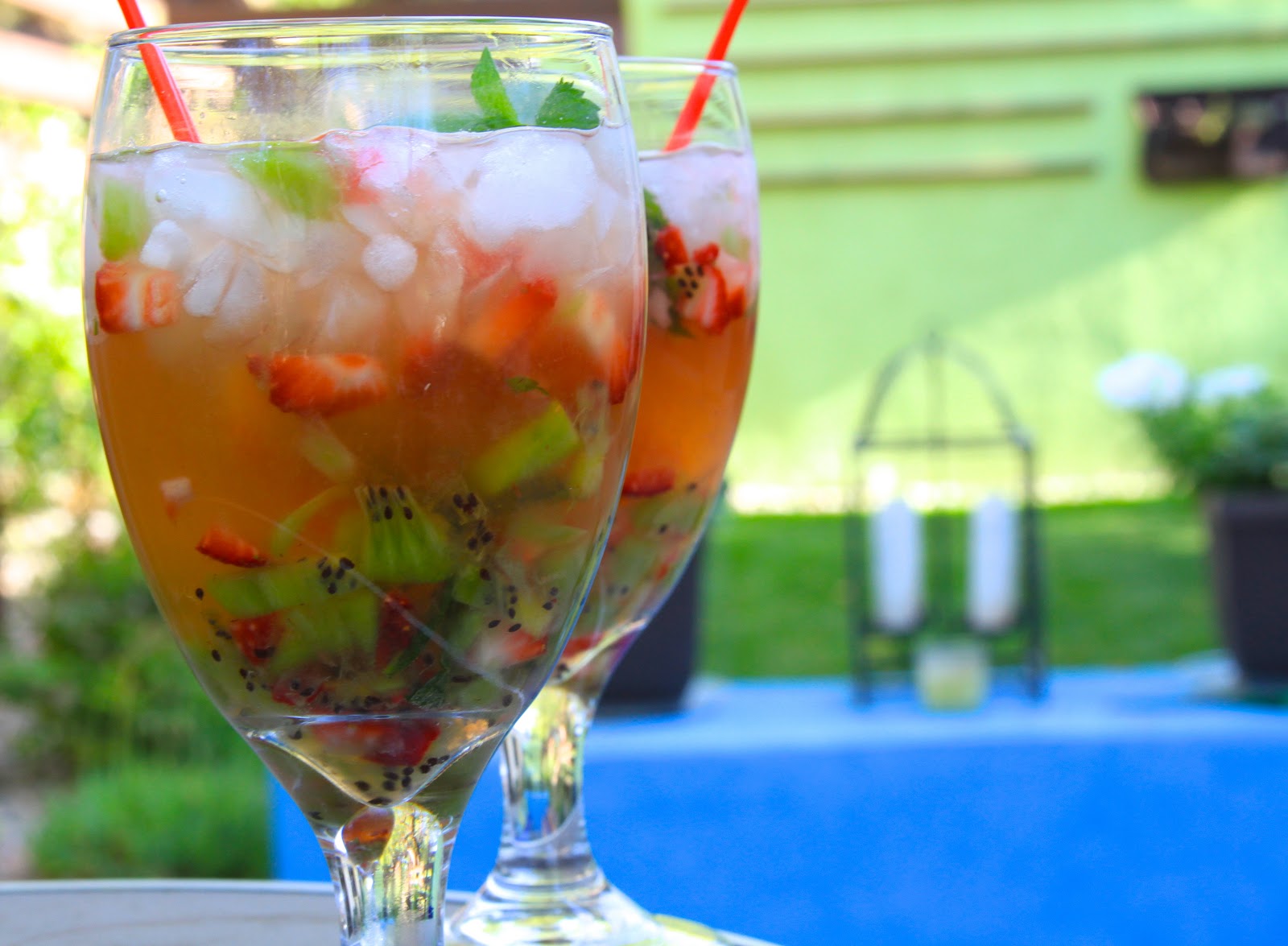
Kiwi Strawberry Caipiroska

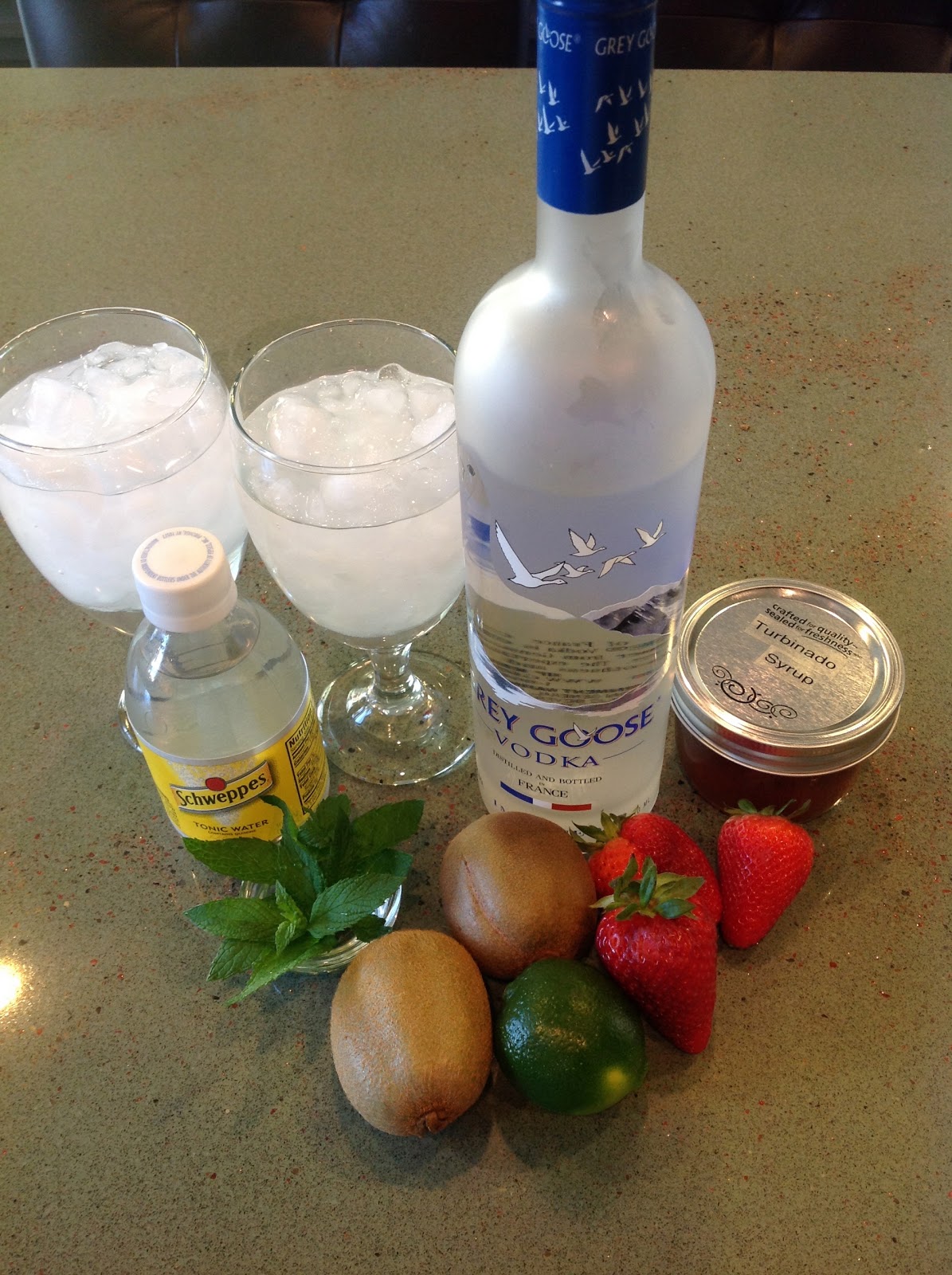
If you thought I was going to go another week without posting a delightfully potent, yet pretty cocktail, then you would be wrong!  I’ve been foraging for new cocktail recipes to try and I stumbled upon a recipe for a caipiroska.  The drink is similar to the Brazilian caipirinha, but instead of using cachaca, it is prepared with vodka, which I had on hand.  There seem to be many different versions of the drink, but the common denominator seems to be lime, sugar and vodka.  During a particularly fruitful forage on Pinterest, I stumbled across this kiwi caipiroska recipe.  The picture was so very pretty and the drink looked so refreshing; perfect for a hot day like today (it was 95 degrees)!  So, off the the grocery store I went and since both kiwi fruit and strawberries were on sale, it seemed like a match made in cocktail heaven. By the way, I am drinking the caipiroska as I write, which is, once again, proving quite difficult!  I should call myself The Tipsy Blogger!

For each drink, you’ll need:

4 mint leaves
1/3 cup good quality vodka.  I prefer Grey Goose–very smooth!
1/2 ounce simple syrup
1/2 lime, juiced
1/2 kiwi fruit, diced
1 strawberry, diced
tonic water

Muddle the mint leaves, simple syrup, kiwi fruit and strawberries in a chilled glass until well mixed.  Fill the glass with ice and add the vodka and lime juice and stir to incorporate.  Then add tonic water to fill the glass and give it a quick stir.  Cheers!

Pork Shoulder Two Ways: Pork Chili Verde

I entered my very first chili cook-off yesterday with a chili recipe I created using braised pork shoulder, fire roasted tomatillos, yellow chiles and serrano chiles.  I used the recipe for carnitas, only instead of broiling the pork as you would for the tacos, I put the pulled braised pork into the crock pot with the other ingredients for about 4 hours.

Braised pork shoulder with fat removed and pulled into chunks
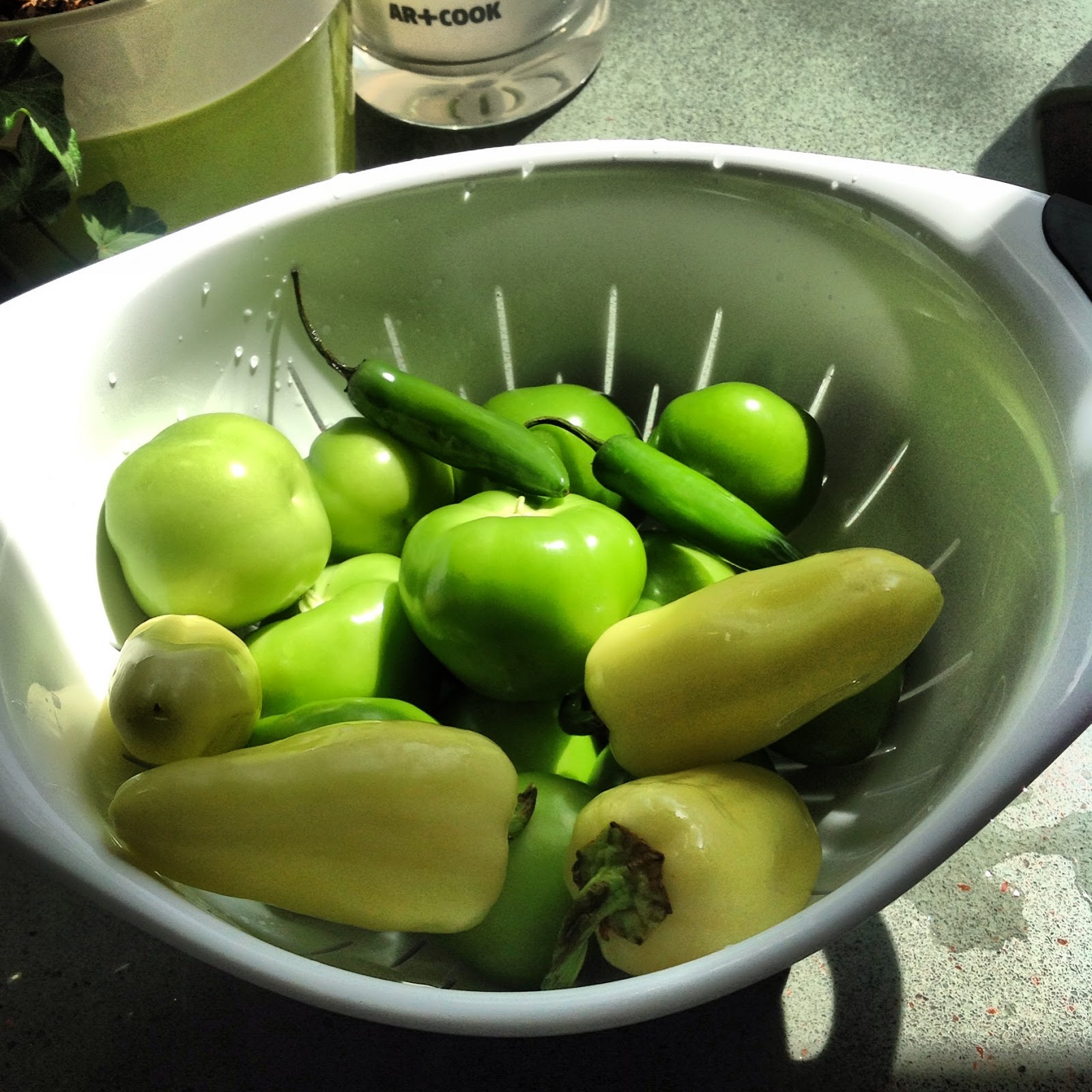
15 to18 tomatillos
4 to 6 yellow chiles (depending on how much heat you like)
4 Serrano chiles (again, depending on how much heat you prefer)
1 tablespoon cumin
2 teaspoons coriander

1 large onion finely chopped
6 cloves garlic, minced

1 15 ounce can of pinto beans with jalapeños, undrained
1 15 ounce can of white beans, undrained
1 juiced lime
2 tablespoons chopped cilantro
Braising liquid from the carnitas
2 bay leaves
Salt and pepper

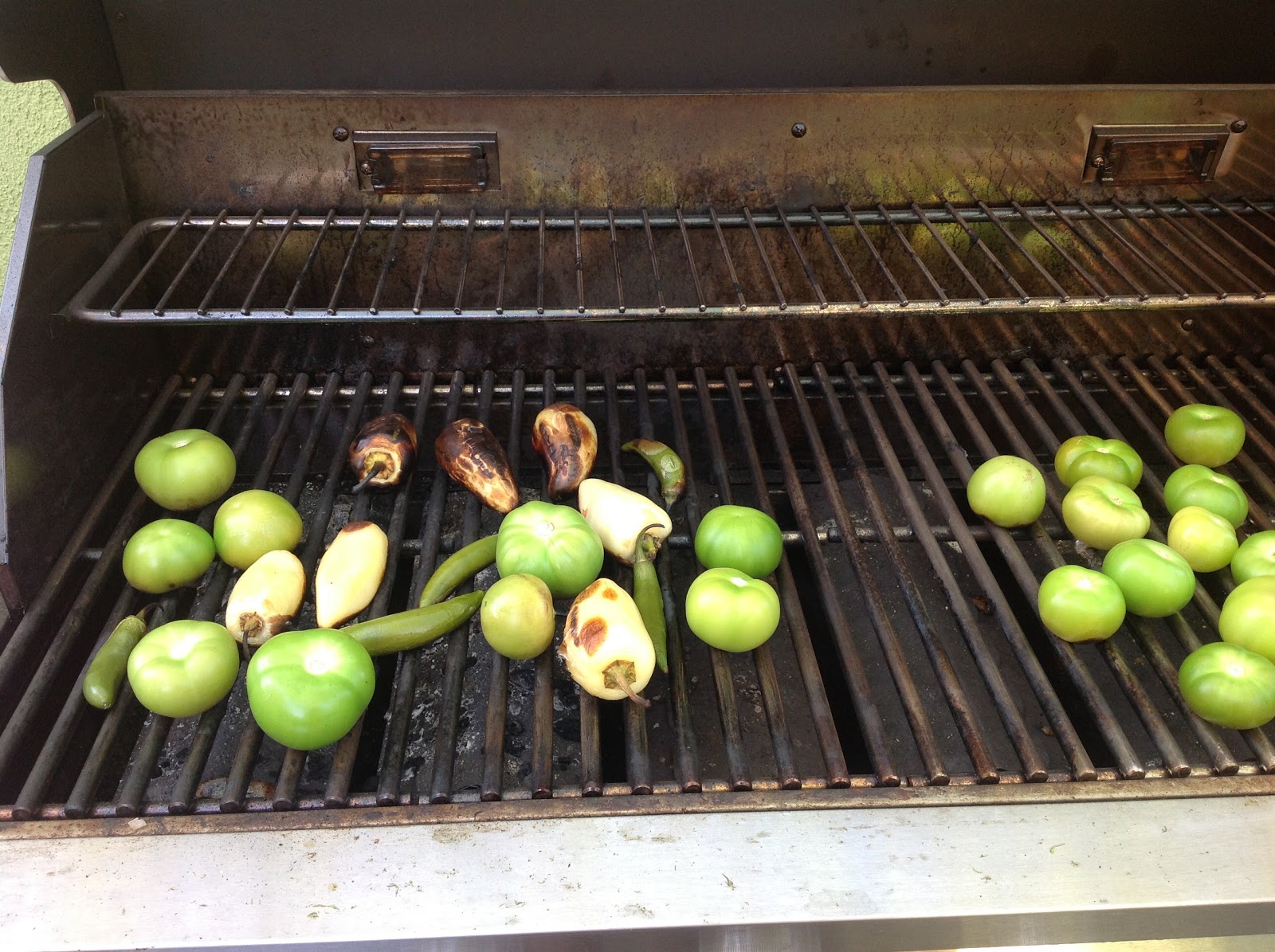
To prepare tomatillos, remove the papery skin and discard. You will find that they are also quite sticky and will need to be thoroughly washed before cooking.  While the pork was braising, I fire-roasted the chili peppers and the tomatillos on a very hot grill.  You could also do this under your oven broiler on a large flat pan if you would prefer to not use the grill.

Turn the peppers and tomatillos until they are nice and charred.  The pepper will be done first.  Remove them from the grill and allow them to cool.  When the tomatillos are done cooking they are very soft and the juices will start to seep out, so carefully remove them from the grill with tongs and try not to lose the flesh.  Place into a bowl to cool.

After the peppers have cooled, carefully and with gloved hands, remove the charred skin and the stems and discard.  The seeds of the chile pepper contain a lot of the heat and I like my chili a little spicy, so I left the seeds intact.  If you like a milder chili, remove the seeds.  Put the cooled tomatillos and the chile peppers into a food processor and pulse until they are well chopped and mixed.  Pour the mixture into a crock pot.

Sauté the onion and the garlic in a frying pan with a little vegetable oil until they soften, about 3 to 4 minutes.  Add the cumin and coriander to the onions and garlic and cook for an additional 2 minutes and then add the mixture to the crock pot.

Add the pork, beans and about a cup of the braising liquid to the crock pot.  I poured the braising liquid into a gravy seperator so that the fat could separate before adding the liquid to the crock pot.  After the chili has cooked for about an hour, check for seasoning and add about 1/2 teaspoon (or more, if needed) of salt, pepper, the lime juice and the cilantro. Cook in the crock pot for about 3 to 4 hours on high heat.  As with any soup, stew or chili, I find that it’s best to make the dish and allow it sit overnight to allow the flavors to develop, but it’s great the first day, too!

I’m happy to say that this chili took first place in the contest!  It was a fun day and I hope that our hardworking Administrative Professionals felt our appreciation for all the hard work that they do!